

Professional Sheet Metal Prototyping Services
Sheet metal prototyping is a manufacturing process for rapidly producing metal parts. It is commonly used to check product design, structure, and function. As an efficient and rapid prototyping method, it helps companies test product performance before mass production. Therefore, this processing method is widely used in many industries such as automobiles, medical, electronics, and industrial equipment.
RFS offers professional sheet metal prototyping services, capable of manufacturing high-precision metal prototypes and components according to customer design requirements. Our services cover the fabrication of everything from simple parts to complex assemblies, supporting a variety of sheet metal materials and processing methods. Whether it’s automotive parts, equipment housings, or medical device structural components, RFS provides rapid and reliable prototyping solutions to help customers shorten product development cycles and reduce development costs.
Get A QuoteSheet Metal Prototyping Process
RFS’s sheet metal prototyping process typically comprises four stages: design, analysis, manufacturing, and quality inspection.
First, the client sends us a 3D model or drawings. We check and confirm the parts are suitable for sheet metal fabrication. Then, we choose the manufacturing processes based on material, dimensions, and functional requirements.
After the customer confirms the design, RFS will make the detailed plan, including the processing steps, process parameters, and equipment settings. Technicians use sheet metal processing techniques such as laser cutting, bending, welding, and stamping to manufacture the prototype parts.
Once the parts are fabricated, our quality team checks the parts’ dimensions and surface finish to ensure they meet customer standards. Finally, the inspected sheet metal prototypes are delivered to the client for product testing and mass production development.
Get A Quote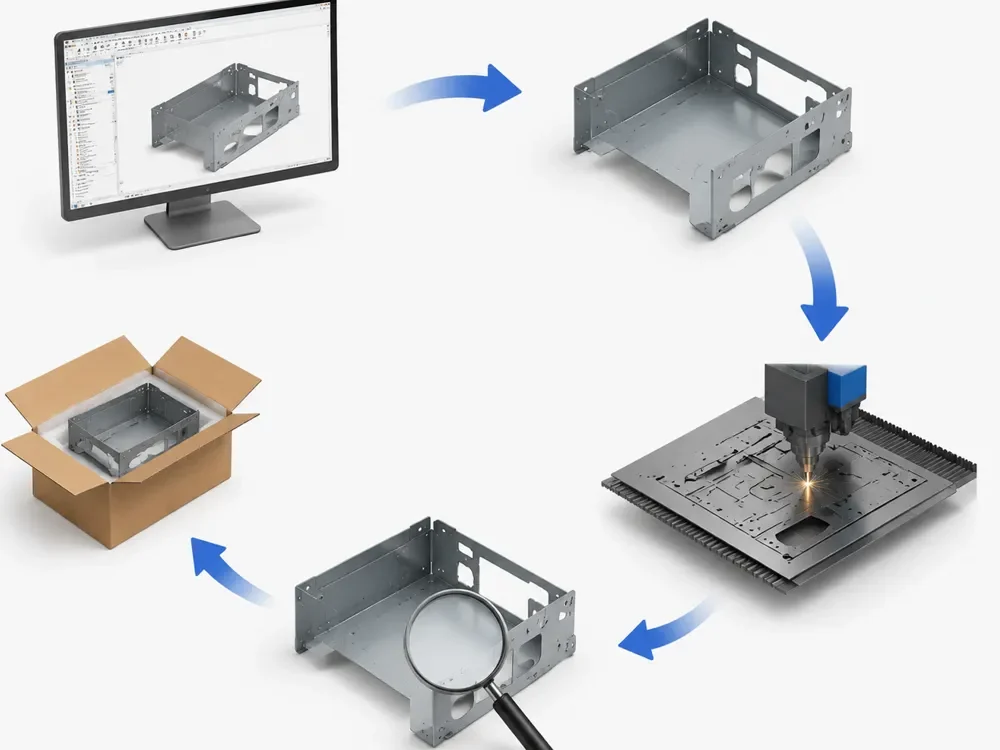
Why Choose RFS
Ultra-fast speed to meet your R&D cycle
We typically deliver high-precision sheet metal prototypes within 2 to 5 business days of receiving your 3D drawings. From initial drawing review (DFM) and laser cutting to bending and surface finishing, we respond rapidly.
A Powerful Factory with Solid Processing Capabilities
Our modern manufacturing plant covers an area of 6784 square meters and is equipped with industry-leading processing equipment. We can handle not only common aluminum, steel, and stainless steel, but also various metal materials such as copper alloys. Relying on a powerful equipment cluster and experienced technical workers, we are capable of undertaking various demanding tasks, from the R&D of single complex structural components to low-volume production, using our true factory strength to safeguard the successful launch of your products.
Customer-Centric Approach, More Than Just Words
We don’t see ourselves as a mere OEM manufacturer, but rather as an extension of your R&D team. At RFS, every project represents a trust. Whether your order is for a single sample or hundreds of prototypes, we treat them all the same. When faced with design changes and urgent modification requests, our team maintains highly flexible communication. During the prototype sheet metal fabrication process, you only need to focus on the design.
Get A QuoteRapid Sheet Metal Prototyping Capabilities
We have comprehensive sheet metal manufacturing capabilities that provide reliable support for prototype development and assembly projects. With our diverse processing technologies, we can quickly produce everything from simple sheet metal parts to complex molded parts and welded assemblies, meeting the needs of different projects.
Explore our capabilities:
→ Stamping
→ Forming
→ Bending
→ Welding
Get A Quote
Materials and Surface Treatments
Sheet metal prototyping supports a variety of metal materials, which can be matched according to the product’s strength, weight, corrosion resistance, and application environment. Common materials include carbon steel, stainless steel, aluminum, copper, brass, bronze, and nickel alloys. Different materials can meet a variety of needs, from functional testing to appearance presentation.
In addition to material selection, surface treatment is also important for improving the appearance and performance of sheet metal prototypes. We offer a variety of surface treatments, including anodizing, powder coating, spray painting, electroplating, nickel plating, sandblasting, wire drawing, and screen printing. Through professional surface treatment processes, the wear resistance, corrosion resistance, and appearance of parts can be improved. Prototypes are suitable not only for functional testing but also for applications such as exhibition display, customer review, and product verification.
Get A Quote
Advantages of Sheet Metal Prototyping
- Economical and efficient design verification
Sheet metal prototyping is a low-cost method for verifying design concepts. Before investing in mass production, companies can test the structure, assembly effect, and function of their products using prototypes. This reduces development risks and upfront investment.
- Rapid delivery of prototype parts
Sheet metal processing uses laser cutting, bending, stamping, welding, and other processes to quickly transform CAD designs into actual parts. Automated processing equipment reduces manual operation, improves production efficiency, and shortens the prototype production cycle.
- Flexible design capabilities
Sheet metal fabrication supports a variety of manufacturing methods to meet different size, structural, and functional requirements. Whether it’s a simple part or a complex geometry, we can achieve customized production through cutting, bending, and forming.
- Multiple material options
Sheet metal prototypes can be made from a variety of metal materials such as stainless steel, aluminum, carbon steel, and copper. Different materials can meet the different requirements of products in terms of strength, weight, corrosion resistance, and appearance.
- Reduce material waste and manufacturing costs
By optimizing layout and processing techniques, sheet metal processing can improve material utilization and reduce production waste. At the same time, optimizing the design, such as reducing complex bending or unnecessary processing steps, can also help to further reduce costs.
Get A QuoteApplications
Many customers will create a prototype before starting production. Some customers wanted to confirm the dimensions, some wanted to check the assembly, and some just wanted to get a sample to see the actual effect. RFS works on many prototype projects every year, from simple bent parts to complete equipment casings.
Our completed prototype projects include:
- Control boxes and cabinet enclosures
- Automation equipment racks
- Laser equipment protective covers
- Stainless steel equipment enclosures
- Aluminum alloy product enclosures
- Battery enclosures
- Electrical cabinet enclosures
- Equipment mounting brackets
- Metal panels
- Sheet metal bases
- Non-standard sheet metal structural components
- Complete sheet metal chassis
