
Hardening and tempering are two important heat treatment processes. Manufacturers use these methods to make metals stronger and tougher. However, these two heat treatment methods differ. Understanding the differences between hardening and tempering of metals is crucial.
People consider these two methods to be used for different applications or conditions. That’s only half the truth – both hardening and tempering are important for each other. Metals undergo hardening and tempering to achieve the desired properties. In this article, I will discuss the basics of both hardening and tempering. So, let’s get started.
What is Hardening of Metals?

Hardening is a heat treatment that imparts excellent strength and durability to metals. This process involves exposing the metal to a very high temperature for a specific duration. After this, the heated metal undergoes a very low temperature (quenching). This rapid cooling changes the structure of metals, making them harder, stronger, and more brittle.
This heat treatment is widely used to produce various products subjected to heavy loads or friction. Examples of such products include cutters, knives, gears, and even automotive sheet metal parts. Remember, hardening is an excellent way to increase metal strength through heating and cooling. However, it also makes the metal more brittle and prone to breaking and cracking.
This hardening of metal starts by heating it to a very high temperature. This is typically done using either a gas or electric furnace. Metal remains exposed to high temperatures for an extended duration. This way, the heat is distributed evenly, and the entire metal piece heats up uniformly. After this heating, the metal is removed from the furnace.
However, it is immediately exposed to very low temperatures. This exposure of heated metal to a very low temperature is called quenching. This is done using either water, air, or oil to ensure the metal cools quickly. Remember, water cools metal more quickly than oil, but oil is used because it prevents unwanted cracks in metal.
This exposure to high or sudden low temperature changes the internal structure of metals. This change in temperature causes them to become martensite. At this stage, the metals become very hard and extremely brittle. Due to this brittleness, metal becomes prone to breaking and cracking. However, this process alone is unreliable, as it makes the metal very brittle. Therefore, it is followed by tempering, which reduces the brittleness introduced by this method.
What is the Tempering of Metals?
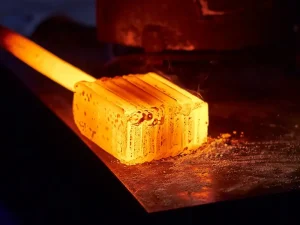
Tempering is another heat treatment process performed after hardening. Metal that becomes hard and brittle during hardening undergoes tempering. This heat treatment reduces its brittleness. After tempering, the metals become tougher, less prone to cracking and breaking. Tempering does not require sudden heating and cooling (quenching).
Hardening is an excellent method for making metal hard, but it also makes it brittle. This brittleness makes the metal less practical for making everyday products. The reason is that using them in everyday life can break them due to their brittleness and fragility. That’s where tempering comes into the scene.
It is worth noting that tempering also involves heating the metals, but in a way that is different from hardening. In tempering, the metal is exposed to low temperatures, around 150 degrees Celsius, for an extended period. This way, the metal remains exposed to a low, steady temperature. This exposure to steady heat improves the metal’s internal structure. Remember, this method is also commonly used in metal fabrication to improve material performance.
As a result, the martensite structure, which arises from hardening, becomes more stable and refined. After a specific duration, the metal is removed from the heating furnace. However, it is not exposed to the very low temperatures used in hardening. Instead, the metal is exposed to air, which cools it slowly rather than immediately.
This slow cooling of the metal is handy, as it reduces internal stress. After this, the metal becomes tougher, stronger, and less brittle. Tempering is a heat treatment method that is always applied after a material has been hardened. In other words, hardening and tempering are inseparable. After tempering, metal becomes suitable for making everyday items.
Difference Between Hardening and Tempering of Metals
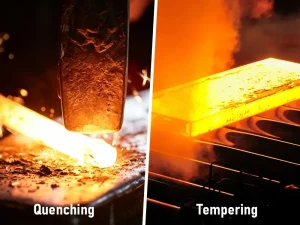
Although these two processes are connected, they differ in many respects. Let’s drill down and discuss the key differences between metal hardening and tempering.
1- Process Type & Heating Pattern
Hardening and tempering differ in their heating patterns. In hardening, the metal is heat-treated at a very high temperature. This temperature can even exceed the metal’s critical point. After some time, the metal is removed from the heating and undergoes sudden cooling. This sudden cooling at low temperature is called quenching, which is part of the hardening process. However, tempering involves heating metal at a low but steady temperature of around 150 degrees Celsius. After a specific duration, this metal is exposed to air, so it cools slowly. Tempering does not involve quenching (unlike the hardening process).
2- Usability & Purpose
Both hardening and tempering differ in terms of their usability and objectives. The hardening is used to make the metal very hard and brittle. After this process, the metal is more prone to cracking but also very hard. On the other hand, tempering is used when metal toughness is the primary requirement. This process also reduces brittleness, making the metal ideal for practical parts and products. Metal cannot be used to make daily-use products if it has undergone only thorough hardening, not tempering. The reason is that metal that has only hardened is brittle; parts made from it would be weak.
3- Sequence in Treatment & Cooling Method
Hardening and tempering methods are used one after another. First, metal undergoes hardening. This process makes the metal both hard and very brittle. This is the initial procedure for making metal useful for everyday products. Once hardening is complete, a tempering process is carried out to make the metal tougher and less brittle. Without tempering, the metal will remain only hard and brittle. If it remains brittle, it cannot withstand stress.
4- Temperature Range & Effect on Hardness
The temperature range is another significant factor that distinguishes these processes. The hardening process involves heating the metal at a very high temperature (above the critical point). Additionally, this process also makes the metal very hard. On the other hand, the tempering process involves heating metal to low temperatures, around 150 degrees Celsius. This lower temperature stabilizes the martensite structure. Additionally, this process reduces the brittleness and hardness of metals and imparts toughness.
5- Internal Stress & Toughness
The hardening process is known to induce internal stress in metals. Why? The reason is that heat treatment involves quenching. In quenching, a metal is cooled from a high temperature to a low temperature. As a result, the metal experiences two different temperatures. Internally, the temperature is low, but the metal’s external surface cools quickly. This creates internal stress, which reduces the metal’s toughness. In contrast, tempering does not involve quenching. In this process, metal is cooled slowly and evenly, resulting in no internal stress. This increases the metal’s toughness, making it stronger.
6- Brittleness & Risk of Cracking
Metal that underwent only hardening is very brittle and prone to cracking. The reason is that hardening induces internal stresses in metals. As a result, the metal becomes unstable and highly brittle. When such brittle metals are under stress or subjected to sudden shocks, they crack quickly. On the other hand, the tempering process does not produce internal stress. So, the metal that passes through tempering has no brittleness. This ensures metal does not crack and remains stable even when exposed to harsh force or stress.
7- Practical Usability & Applications
As discussed above, hardening makes the metal very hard and brittle. Such metals are only useful to make hard tools, i.e., dies, gears, drills, cutters, and so on. However, this metal is not suitable for making everyday items due to its brittleness. That’s where the tempering process is used, as it makes the metal tougher and more durable.
Metal, after tempering, becomes perfect for making a wide range of products. Ideally, the metal must undergo both heat treatments to become tough, durable, and long-lasting. I recommend that you not use metal if it has only undergone hardening. Below is the table showing the application comparison of the hardening and tempering process:
| Hardening Applications | Tempering Applications |
| Cutting tools (drills, cutters) | Springs |
| Knife edges & blades | Gears |
| Dies and molds | Shafts |
| Wear-resistant surfaces | Automotive components |
| Bearings (surface hardening) | Structural parts |
Advantages & Disadvantages of Hardening and Tempering
Remember, hardening and tempering processes offer unique value. In the section below, you’ll get various advantages and disadvantages of these heat treatment processes.
Advantages & Disadvantages of Hardening Method
| Advantages | Disadvantages |
| Increases hardness & strength | High brittleness |
| Improves wear resistance | Risk of cracking |
| Better cutting performance | Low toughness |
| Suitable for heavy-duty use | Needs tempering after |
Advantages & Disadvantages of the Tempering Method
| Advantages | Disadvantages |
| Reduces brittleness | Slight loss of hardness |
| Improves toughness | Requires extra process |
| Relieves internal stress | Needs temperature control |
| Enhances durability | Adds time & cost |
Frequently Asked Questions
Why is tempering done after hardening?
Tempering is performed after hardening to reduce internal stresses and brittleness in metals. It also improves the toughness and strength of metal when used after hardening.
Can metal be used after hardening without tempering?
Yes. Metal can be used after hardening to make various tools, such as drills, dies, and molds. However, manufacturers generally prefer metal that has undergone both hardening and tempering. This ensures metal has excellent toughness and reduces brittleness.
Conclusion
Many get confused about hardening vs. tempering. Remember, both of these heat treatment methods are important for making metals usable. Hardening makes the metal brittle and hard, while tempering does the opposite. Tempering also reduces internal stress and improves the toughness of the metals. It is worth noting that hardening is always performed first. After that, the metal becomes hard and undergoes tempering to reduce its brittleness. In this article, I have discussed everything about both hardening and tempering. Remember, these two methods are inseparable and mutually dependent.