
Copper is widely used to make wires and other electrical components. Its use in aerospace, automotive, and electronics cannot be overstated. This material is very popular due to its versatile properties. However, when it comes to the density of copper, many seem clueless. There is a misconception that density refers to the weight of materials, which is wrong.
Remember, knowing copper’s density is crucial if you want to use it to make a different product. When you know the density, you can use this material more effectively. In this article, I will discuss everything about the density of copper and its importance for CNC machining. So, let’s get started.
What is the Density of Copper?

First things first: density refers to the mass of any material contained in a specific volume. In other words, how much mass can be placed in a specific space is density. Materials with higher density have higher weight and occupy less space. In contrast, low-density materials occupy more space and are lightweight.
The density of copper is 8.96 g/cm³ or 8,960 kg/m³. Remember, the density of copper is higher than that of many other materials, including carbon steel. Its higher density contributes to many of its favorable properties. It gives copper higher strength, durability, and higher weight. Engineers generally choose copper for many projects due to its higher density.
Interestingly, the density of copper is a fixed property. However, if you have any copper part or product, you can also calculate its density. For this calculation, you must know the mass and volume a part occupies. Once you know these two values, you can use the following formula to calculate the exact density of your copper part:
Density = Mass / Volume
The density of copper is directly proportional to mass but inversely related to the volume it occupies. Overall, I rate the density of copper as medium compared with other metals. The reason is that few materials are less dense than copper. However, some metals are even denser than copper.
Here is a table that shows a comparison of copper density with other materials:
| Material | Density (g/cm³) |
| Magnesium | 1.74 |
| Aluminum | 2.70 |
| Steel (Carbon) | 7.85 |
| Iron | 7.87 |
| Copper | 8.96 |
| Nickel | 8.91 |
| Silver | 10.49 |
| Lead | 11.34 |
| Tungsten | 19.3 |
Notably, the density of copper determines many of its other properties. For example, its higher density indicates this material is robust, heavy, and durable. Its higher strength makes this material resistant to breaking and difficult to cut and shape.
Factors that Affect the Density of Copper
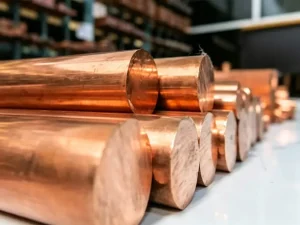
The density of copper is generally considered a fixed property at standard conditions. However, it can vary slightly with certain factors and parameters. In the section below, I will explore these factors to understand how copper’s density depends on them.
1- Impurities (Alloying Elements)
Copper density can change if it gets any impurity in its composition. Similarly, adding alloying elements to copper affects its density. Whether the density increases or decreases depends on the mass or density of the added alloy elements. If the alloy element has a higher density, it increases the density of the copper. If the alloying element is low-density, it will reduce the density of the copper alloy. Similarly, if the impurity is heavier or denser, it would increase the density of the copper, and vice versa.
2- Manufacturing Processing & Forming Methods
As you know, copper undergoes different processing and forming methods. These include rolling, casting, extrusion, forging, and more. These processes can also affect the density of copper. For example, the casting process can create small gaps or air pockets in copper, which reduces its density. On the other hand, processes such as rolling or forging increase the density. How? That’s because they compress the copper, remove air pockets, and make the material occupy less space (reduce volume). When volume decreases, the density of copper increases.
3- Temperature Conditions
An increase in temperature reduces the density of copper. How? The reason is that higher temperatures make copper atoms vibrate and move randomly. These vibrations cause the atoms to occupy more space, resulting in the expansion of the copper. When copper expands, it occupies more space, meaning its volume increases. Once volume increases, the density of copper reduces. In contrast, at lower temperatures, the atoms come closer together, resulting in the contraction of copper. This reduces the volume of copper that occupies. As a result, the density of the copper increases at low temperatures.
4- Crystal Structure & Porosity
Copper has a face-centered cubic (FCC) structure, ensuring atoms are close together in perfect packing. However, if this structure is disrupted, the atoms can be farther apart. This atomic spacing can expand the copper and increase its volume. When volume increases, density decreases, and vice versa. Porosity is another factor that can influence the copper density. Remember, porosity involves the creation of small air pockets in the copper. These gaps or air pockets increase volume, resulting in a reduction in the density of the copper.
5- Extreme Pressure & Stress
The density of copper can also be influenced by pressure and stress. When copper is exposed to extreme pressure, its atoms close very close to each other. This close positioning of atoms reduces the volume of the copper. When volume decreases, the density of the copper increases. When pressure is reduced, the copper’s atoms do not remain in very close positions. This increases the volume, resulting in reduced density. Sudden impact also affects the density of copper by disturbing its crystal structure.
Importance of Density for Metal Fabrication
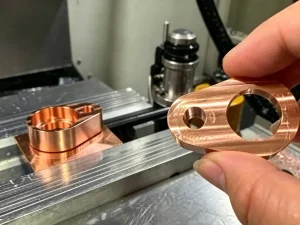
Does higher density make copper fabrication difficult? The answer is No. Despite higher density, the fabrication of copper is relatively easier. The cutting tools don’t have to go beyond their limit to cut and shape this material. In fact, you can even create a strong weld on copper using the preheating technique, due to copper’s higher thermal conductivity.
As you know, metal fabrication involves a set of different processes. These include welding, cutting, machining, forming, and more. If the material is very hard and robust, its fabrication can be more difficult. Due to its higher density, copper can seem hard to cut and fabricate. However, reality is different: cutting and machining this material are relatively easy, as one might think. Why?
The reason is that copper is a ductile material with excellent thermal conductivity. Due to its greater ductility, copper can be cut more easily, and cutters don’t have to exert excessive force. When a material is cut, heat is produced, which could wear out the cutting tool if it remains in the same spot. However, copper dissipates heat effectively, a significant advantage.
When cut, heat moves away, ensuring the safety of the cutters. However, higher thermal conductivity is a drawback when it comes to welding copper. During welding, heat dissipates from the weld area, which is a drawback. This way, the weld becomes weak, which is why copper needs preheating before welding. Once you pre-heat, welding copper becomes a bit easier. Simply put, welding, cutting, and machining (fabrication) of copper is easier and possible despite its higher density.
Does the Density of Copper Really Matter for Machining?
Yes. Considering density for CNC machining is very important. In fact, density is one of the most fundamental parameters influencing machining ease. As I mentioned above, copper density influences many of its other properties. These include strength, hardness, weight, and so on. If the material is hard, it would be difficult to machine, and vice versa.
In the section below, I will discuss how copper density must be a key consideration in its CNC machining.
1- Role of Density in Machining Performance
The density of copper is important for the precision of CNC machining. As I said earlier, copper has a medium to high density. This means it is heavier, more robust, and less likely to vibrate. During CNC machining, the clamped workpiece can vibrate when the machine runs. However, copper does not vibrate much when clamped, thanks to its high density and stability. As a result, the cutting tools easily cut and shape copper materials. If copper were less stable, it would vibrate, affecting the precision of CNC machining.
2- Role in Ease of Cutting
As you know, copper has a high density, which makes it stronger. However, when it comes to cutting, density makes copper resistant to cutting. This can be a drawback because cutting tools must exert more force. Interestingly, copper is highly ductile and widely used because of its softness. This softness makes cutting, fabrication, and shaping much easier during CNC machining. Despite its high density, copper can be machined relatively easily.
3- Effect of Density on Material Stability
High-quality surface finishing is the primary requirement when you use a CNC machine to make any part, right? However, if the material used is unstable, it vibrates and moves during CNC machining. This vibration reduces the precision and affects the quality of surface finishing. However, copper is a dense material with excellent stability. During CNC machining, this material does not vibrate, and cutting tools cut with precision. As a result, you get copper-made parts with excellent surface finishing.
4- Density Influences Tool Wear
CNC machines use cutting tools to move and cut the workpiece (material). If the material is hard and stiff, the cutters can wear out quickly. This causes these cutters to deteriorate, and they need to be replaced. Unfortunately, copper is also dense and stiff. During cutting, when cutters contact copper, they experience friction and constant rubbing. This friction contributes to the rapid wear of the cutting tools. When choosing copper as a workpiece, you should be aware of the wear during machining.
5- Effect of Density Fixture Selection and Clamping Methods
Copper is denser and heavier than many other metals and alloys. Due to its high weight, you’ll have to choose the right fixture and clamping method. If the fixture is loose or weak, it may not hold the copper firmly. It is worth noting that CNC machines generate vibration during cutting and machining processes. This vibration can affect the precision if the material is not held firmly. Therefore, you should choose a clamping method that holds the copper firmly so it does not vibrate during CNC machining.
6- Heat Production During CNC Machining
As you know, copper has high heat conductivity, which is a significant advantage. However, when CNC machines cut copper at high speeds, heat dissipates slowly. As a result, heat can build up in a localized area, leading to a high temperature there. This high temperature can cause cutting tools to overheat. This overheating of cutting tools can be dangerous and cause them to wear out quickly. I recommend adjusting the cutting speed when machining copper to handle heat buildup efficiently.
Frequently Asked Questions
What is the density of copper in kg/m³?
The density of copper is 8,960 kg/m³. Remember, the density of copper remains the same, but you see different values due to a change in the units of density.
What is the density of copper in g/mL?
The density of copper is 8.96 g/mL. Remember, mL and cm³ are equivalent. So the density is 8.96 g/mL and 8.96 g/cm³.
Is heat manageable in copper despite its density?
Yes. Heat is manageable during CNC machining of copper. The reason is that copper has higher heat conductivity. This means heat dissipates and moves away during machining.
Conclusion
In conclusion, density is an important parameter that must be considered seriously. Copper is one of the most popular materials that is used in a wide range of industries. Its extensive use in the electronics sector is highly widespread. However, it is crucial to know its density before selecting it for any product.
It is worth noting that CNC machining for various copper parts is becoming common. Although copper has a high density, it is relatively easy to machine with CNC. The reason is that this material is soft, which makes its cutting a bit easier. In this article, I have discussed everything about copper density and its role in CNC machining.