
Stainless steel is one of the most trusted metals in the world due to its durability, strength, and excellent corrosion resistance. However, before stainless steel turns into any useful product, its separate pieces must be joined properly. That’s where welding comes into play. However, welding stainless steel is not as easy as ordinary metals. It requires careful steps and special welding techniques to create a strong weld. However, if you are new to this topic, worry not! This guide to welding stainless steel will make things easier for you. I will discuss how to weld stainless steel, different techniques, and safety tips. So let’s get started.
Why Is Welding Stainless Steel Different from Regular Steel?

When you look at ordinary steel and stainless steel, they might look the same. But in reality, there are huge differences that affect their welding procedures. The first reason welding stainless steel differs from ordinary steel is its composition. Basically, stainless steel contains chromium. It forms a thin protective layer on the surface that helps prevent rust and corrosion.
Regular steel does not have this same level of protection. But during welding, too much heat can damage this protective layer, so stainless steel needs more careful handling. Secondly, stainless steel itself reacts differently to the heat. It expands and contracts more than regular steel as its temperature changes. If the heat is not controlled properly, it can bend, twist, or lose its original shape.
Lastly, stainless steel also retains heat for a long time. If it is not dissipated, it can cause overheating, which can change the properties of the stainless steel. If properties change, stainless steel will not be able to perform like before. However, all these causes make stainless steel welding harder in metal sheet fabrication, but not impossible. So, manufacturers use special welding techniques, lower heat input, a steady welding speed, and the right filler to make a strong weld.
Common Welding Methods for Stainless Steel
Now you understand why stainless steel requires special attention during welding. Right? Next, remember that regular welding machines or methods cannot weld it. Instead, it needs specialized techniques that can handle the nature of stainless steel and create a strong, durable weld. So let’s dive in and explore the common welding methods for stainless steel.
1- TIG Welding (GTAW)
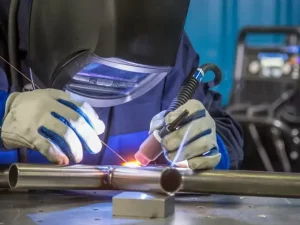
TIG welding, also called Gas Tungsten Arc Welding (GTAW), is one of the most popular methods to weld stainless steel. It uses a non-consumable tungsten electrode to create an electric arc. That electric arc melts the edges of the stainless steel. Now, these melted edges are quickly joined to create a strong joint.
If extra material is needed to strengthen the joint, a separate filler rod is added by hand. At the same time, a shielding gas, usually argon, also blows from the welding machine to protect the weld from air and contamination. One of the most special things about TIG welding is the high level of control it gives the welder. Here, the heat and filler metal are controlled separately, so it is much easier to create an accurate weld without creating too much spatter.
2- MIG Welding (GMAW)
Another common technique for welding stainless steel is Gas Metal Arc Welding (GMAW). In this process, a welding machine automatically feeds a thin wire through the welding gun. This wire acts as the filler metal and melts together with the stainless steel to form a strong joint. This means that welding and filling are occurring simultaneously.
With these two, a mixture of argon and other gases is also blown in to protect the weld from air and keep it clean. Manufacturers mainly prefer this welding method for stainless steel as it is very easy and fast. The filler wire is fed automatically. That’s why welders focus more on guiding the welding gun rather than adding filler by hand. All this enables precise welding, making it faster and more reliable.
3- Stick Welding (SMAW)
Now it comes to stick welding, also known as Shielded Metal Arc Welding (SMAW), which has been used for centuries. Instead of using a wire, it uses a metal rod called an electrode or welding stick. When the rod touches the stainless steel, it creates a hot electric arc. That hot arc melts both the rod and the stainless steel edges. As the rod melts, it fills the gap between the two pieces and joins them together.
The coating on the rod also forms a protective layer that shields the hot weld from air. One reason many people still use stick welding is that it works well in places where other welding methods may not. For example, you can use it outdoors because strong winds do not affect it. The welding machine for this method is also easier to carry and operate. However, after the weld is finished, a hard layer called slag forms. You must remove that layer for a clean weld, which takes time.
4- Flux-Cored Arc Welding (FCAW)
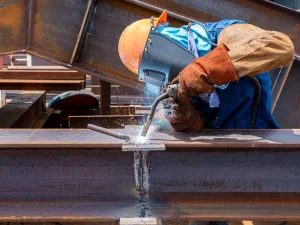
Lastly, there is Flux-Cored Arc Welding (FCAW), which is considered reliable for welding stainless steel. This method is quite similar to MIG welding. The main difference is that it uses a special hollow wire filled with flux instead of a solid wire. As the wire melts during welding, the flux within it forms a protective shield around the weld. This shield helps protect the hot metal from air and other contaminants.
This welding method is known for its faster speed. It can weld thick stainless steel much faster than many other welding methods. Secondly, it also creates deep weld penetration, which means stronger welds can be created on thick stainless steel sheets. But one drawback of FCAW is that it creates much smoke and spatter, which sometimes causes suffocation.
Step-by-Step Guide to Welding Stainless Steel
Now that you know the basic welding methods appropriate for stainless steel, welding it is much easier. You just need to follow a few steps carefully and pay close attention. Afterward, the results will be a clean, smooth, and strong weld on stainless steel. So let’s discuss the major steps involved in stainless steel welding.
Step 1: Choose the Right Welding Method
Before you start, the first step in welding stainless steel is to choose the right method. As I said above, there are different welding techniques. However, this does not mean that all of them work equally well or are suitable for any type of stainless steel. So you have to carefully choose the welding method based on the stainless steel thickness and the weld quality you want. For example, if you are working with thin stainless steel, TIG welding is usually the best option. If your project involves thicker metal, MIG welding is best as it works quickly and saves you time. So keep all the requirements in mind, and then make the right choice of welding method.
Step 2: Select the Correct Filler Metal
Once you have chosen the right welding method, the next step is to select the appropriate filler metal. A filler metal is the material that melts during welding to fill the gap between two stainless steel pieces. Its main job is to create a strong joint and prevent the weld from rusting. So, mainly for its selection, you must choose the one that matches the type or grade of stainless steel you are welding. For example, if you are welding 304 stainless steel, you have to use filler metal designed for it.
Step 3: Set the Correct Welding Parameters
Before you begin welding, you need to adjust the welding machine to the correct settings. These settings are called welding parameters. These parameters include the welding current (amperage), voltage, wire feed speed (for MIG or FCAW), and shielding gas flow. These values are what actually control how much heat is produced and how the weld is formed. To set these parameters, you have to consider the stainless steel thickness, the welding method, and the filler type. For thin stainless steel sheets, you will need a slower speed and lower heat, and vice versa.
Step 4: Tack Weld the Pieces & Start Welding
Now you have set the right welding parameters. Right? Now it is finally time to start welding. However, before that, you have to tack-weld the stainless steel pieces together. What is this? Actually, tack welds are small temporary welds placed at a few points along the joint. These small welds act as temporary supports that hold the stainless steel.
As a result, when you apply heat, there is no risk of unnecessary movement that can cause uneven welds. After the pieces are secured with tack welds, you can now begin the final welding process. Move the welding torch or electrode at a steady speed. Try to keep the welding arc as consistent as possible and maintain an even distance from the metal.
Also, when you are welding, avoid trying to finish the job too quickly. Stainless steel is sensitive to excessive heat, like aluminum. Right? So, if you stay in one spot for too long, it will cause the metal to bend, change color, or lose some of its corrosion resistance. Also, do not move too fast, as the weld will not be strong.
Step 5: Allow the Metal to Cool Naturally & Inspect
After welding is complete, many beginners make the mistake of trying to cool the stainless steel too quickly. However, that’s a wrong practice. Let it cool naturally on its own. If you try to pour water or use another cooling method, it will create stress inside the weld. As a result, after cooling, the weld will become weak and quickly separate. Once it cools down, inspect the weld carefully. Look closely at the entire weld line to make sure it is smooth, even, and fully joined from one end to the other. Make sure there are no visible cracks, holes, or large gaps. If that weld is consistent, even, and smooth, you have done the job very well.
Safety Tips for Welding Stainless Steel
No doubt it seems very simple to weld stainless steel. However, this process involves working with high heat, sparks, and electricity. A slight mistake in handling can lead to serious accidents and injuries. That’s why, before you start welding, here are some safety tips you must consider.
- First, you must wear personal protective equipment (PPE). PPE includes a welding helmet, gloves, goggles, and flame-resistant clothing. The helmet will protect your eyes and face from the bright welding arc. At the same time, gloves and protective clothing will protect your body.
- Secondly, always work in a well-ventilated area. Actually, welding produces fumes which, if inhaled, can cause severe lung problems. If you are working indoors, use exhaust fans or a fume extraction system.
- Welding creates sparks that can travel several feet away from the workpiece. If these sparks land on paper, wood, cloth, fuel, or other flammable materials, they can quickly start a fire. So always keep your working area clean and free from flammable materials. It is also a good idea to keep a fire extinguisher nearby and know how to use it.
- Before starting a welding job, inspect your welding machine, cables, torch, and electrode holder. If there are any damaged or loose cables, they might cause electric shock. So if you notice any damaged parts, replace them quickly before they cause a serious problem. Also, use all welding equipment according to the manufacturer’s instructions.
- Lastly, protect your eyes and skin. Actually, the welding arc emits bright light containing harmful ultraviolet (UV) and infrared (IR) rays. If you look directly at this arc, it will cause a painful condition known as “arc eye” or flash burn. Your skin can also be burned by these rays, even if you are not standing very close to the weld. So use proper goggles and cover your body completely.
Conclusion
Stainless steel is one of the most reliable metals that you can see in several products around you. However, before it becomes useful, it often needs to be joined. For this, welding comes into the scene. But the big problem is that welding stainless steel is different from welding regular metals. It has chromium, which, if deteriorated, reduces its corrosion resistance.
That’s why manufacturers use special welding techniques and careful steps to weld stainless steel. In this article, I have discussed those steps and methods. But when welding, safety should be your priority. So always wear PPE, keep the area clean, protect your eyes, and work in a well-ventilated area.