
Metal surrounds us, from daily items to the huge structures that define industries. But have you ever wondered how raw metal is turned into strong frameworks or useful products? The answer lies in the metal fabrication process. It is one of the most critical processes in modern industry. But a question arises: What is metal fabrication?
Understanding this technique is key to grasping how the world around us is built. Moreover, knowing its types helps you choose the right method for your business. So, are you new to this concept and want to gain a clear understanding? You are at the right place. This article will cover all aspects of metal fabrication, including its types and uses. So, let’s get started!
What is Metal Fabrication?

Let’s first understand metal fabrication!
Metal fabrication is the process of transforming raw metal into usable products or structures. It is not a single-step process. However, it involves several steps, including cutting, bending, welding, and assembling metal parts. As a result of all these steps, you get a refined and polished product.
As you know, in basic manufacturing, manufacturers use ready-made components. But, metal fabrication starts with raw metal such as steel, aluminum, copper, or iron. These raw materials are shaped and modified until they meet the exact design requirements of a project. But you must wonder how this metal fabrication process is performed?
Actually, it starts with designing a model. Engineers use CAD (Computer-Aided Design) software to create blueprints or digital models of the product. After that, based on the design, the appropriate metal is chosen. For example, stainless steel for durability, aluminum for lightweight, or copper for conductivity. Once you select the material, it comes to cutting the metal.
You have to cut down the large sheets, bars, or blocks of raw metal into workable sizes. Modern fabrication uses laser cutting, plasma cutting, or water jet cutting for precise results. After cutting, these pieces are finally shaped into the required angles and curved. For this, machines like press brakes commonly bend the metal without cracking it.
If you are making large structures, you have to join the small parts by welding. Once the basic shape is ready, the machining process begins to fine-tune the product. In machining, processes like drilling, milling, and turning shape the part precisely. The finishing process enhances both the look and function of the final product.
Types of Metal Fabrication
The above section was all about giving you the basic know-how of metal fabrication. However, it is a broad field with many types depending on the purpose and process. Those types help you choose the best method for your project. So let’s dive in and explore the common ones.
1- Cutting
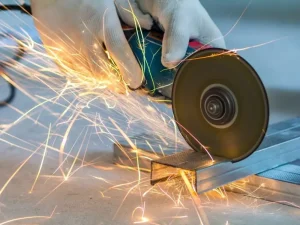
Cutting is one of the main types of metal fabrication. In this type, large pieces of raw metal are divided into smaller sections to get the required size or shape. You can use various techniques for cutting the metal sheets. The common methods include laser cutting and plasma cutting. Each of these techniques has its own advantage. For example, laser cutting is extremely precise. However, plasma cutting is speedy for thick metals. This type is the foundation for all other fabrication processes.
2- Casting
Casting is another primary type of metal fabrication. It is an older fabrication type that allows complex shapes to be made easily. In this type, metal is first heated until it melts into a liquid form. This molten material is then poured into the mold. Mold is a hollow cavity designed to match the final product. Once the molten material cools and solidifies, it takes the exact shape of the mold. Unlike cutting or bending, where you work on solid metal, casting works with liquid metal. This makes it possible to create detailed designs, curves, and hollow sections.
There are three further types of casting, such as:
- Sand Casting: Uses sand molds. It is suitable for large parts like engine blocks.
- Die Casting: Uses strong metal molds and is best for mass production of precise parts.
- Investment Casting: Uses wax molds and allows fine details for smaller components.
3- Forging
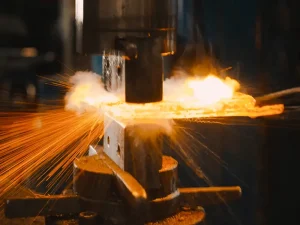
Forging is a type of metal fabrication where metal is shaped using force. Instead of melting the metal, forging uses hammering or pressure to turn the metal into the desired shape. Actually, this process makes the final product stronger than the previous one. WHY? Actually, during hammering, the internal grain structure aligns, which increases durability and toughness. Moreover, you can perform the forging in two ways. Those include:
- Hot Forging: The metal is heated until it becomes soft and easier to shape, but not melted. You can use it for large and complex shapes.
- Cold Forging: The metal is shaped at room temperature. This gives a better surface finish and precision, but is mainly used for smaller parts.
4- Welding
Metal sheet welding is another common type of metal fabrication. It is the process of joining two or more pieces of metal. You can do it by applying heat, pressure, or both, so that the parts fuse and form a single solid piece. Unlike bolts or adhesives, welding creates a powerful bond. HOW? Basically, during welding, the metals melt and mix at the joint. There are several welding methods. The most common ones include:
- MIG (Metal Inert Gas) Welding: It uses a wire electrode and gas. The wire melts and fills the gap between the metal. At the same time, inert gas comes from the welding gun and protects the weld from dirt.
- TIG (Tungsten Inert Gas) Welding: A sharp tungsten needle makes a very hot arc that melts the metal. However, gas protects the weld, making it very neat and strong.
5- Brazing and Soldering
Brazing and soldering are types of metal fabrication that join pieces of metal together. However, these types do not melt the base metal as welding does. Instead, you use a filler metal with a lower melting point. This filler metal is heated and used to bond the parts. When the filler metal cools down, it forms a strong joint.
Both of these metal fabrication types follow the same principle. However, the difference lies only in the temperature. For example, brazing is done at higher temperatures (above 450°C / 840°F). On the flip side, soldering is done at a lower temperature. Therefore, it is best for delicate and thin parts.
6- Stamping
Sheet metal stamping is another common type of metal fabrication. In this process, a sheet of metal is pressed into a specific shape using a stamping press and a die. HOW? Actually, a flat sheet of metal is placed on the stamping press. However, a die with a specific shape and punch is positioned inside the press. The press pushes the punch down with great force. This presses the metal sheet into the die. As a result, the metal takes the exact shape of the die (cut, hole, bend, or design).
7- Machining
Machining means cutting away excess metal using specialized machines. So in this type of metal fabrication, material is removed from a piece of metal to shape it into the desired size and design. Unlike the above types that join the metal pieces, machining cuts away extra portions to achieve the precise dimensions. For this process, the standard machine tools are lathes, milling machines, or drills. This process is widely used where accuracy is the ultimate criterion. In industries like aerospace and automotive, machining makes sure even the tiniest parts fit just right.
8- Extrusion
Extrusion is a metal fabrication type where a block of metal is pushed or drawn through a shaped opening, called a die. This creates long, continuous pieces with a fixed cross-section. The cross-section can be round, square, or even complex shapes like channels. Hence, this process is used to make products like pipes, rods, window frames, and rails. However, depending on the need, you can do it in two ways. The first is hot extrusion, where the metal is heated to make it easier to push through the die. However, in cold extrusion, the metal is pushed through at room temperature.
9- Punching
Punching is a metal fabrication type that creates holes or shapes in a metal sheet. This process works with a machine called a punch press. It holds a tool(punch tool) that has a desired hole shape. So the punch press pushes the tool down with great force. The tool cuts through the sheet and pushes out the unwanted part. The removed part is called a slug. Punching is often used to create holes for screws, bolts, or decorative patterns. This method is speedy and accurate, which makes it ideal for mass production.
10- Shearing
Shearing is the simplest metal fabrication that cuts large sheets of metal quickly into desired sizes. Unlike sawing, grinding, or burning, shearing does not create chips or heat that melts the material. Instead, it uses a pair of sharp blades in the shearing machine. The metal sheet is placed between these blades. The upper blade is a moving blade, while the lower blade holds the sheet. A hydraulic power moves the upper blade down. As a result, metal is sliced along a straight line, creating smooth, even cuts.
Applications of Metal Fabrication
Types of sheet metal fabrication show their diversity. It plays a key role in modern development. So, its applications can be seen in almost every sector around us. Let’s discuss some typical applications of metal fabrication that highlight its value.
1- Construction Industry
The construction industry is one of the biggest users of metal fabrication. Metals like steel, aluminum, and iron are shaped and joined through fabrication methods. Those fabricated metals are used to build safe and modern buildings and large infrastructures. It is also used in roofing sheets, staircases, railings, pipelines, and ventilation ducts. Even bridges and tunnels rely on fabricated metal parts for durability and safety.
2- Automotive Industry
The automotive industry heavily relies on metal fabrication for making vehicle parts. Almost every part of a car, truck, or bus involves fabricated metal. For example, the car body is made from fabricated steel or aluminum sheet. The engine parts, such as cylinders and pistons, are also fabricated with precision for performance. Even the chassis and frame are made through welding and machining to ensure safety.
3- Aerospace Industry
Aerospace is the industry where small precision matters a lot. So this industry also uses metal fabrication to achieve a high level of accuracy in every part of an aircraft. For example, aircraft frames and wings are often made from aluminum alloys or titanium. Fabrication shapes these materials into panels, beams, and structural parts. Engines and turbines also rely on fabricated metal parts to handle high temperatures and pressures.
4- Industrial Equipment
Metal fabrication is also widely used in industrial equipment. Almost every piece of equipment you see in an industry has metal parts that are cut, shaped, or welded to meet specific needs. For example, boilers, pressure vessels, and storage tanks are all made using fabrication methods. Fabricated metals also go into the stamping machines, presses, and mixers. Even the frames and housings that protect machines in industries are made through metal fabrication.
5- Defense and Military
The defense and military sector needs strong, durable, and secure equipment. So all those parts, from weapons to vehicles, are made through metal fabrication. For example, military vehicles such as tanks and armored trucks rely on fabricated metal parts for strength and safety. Also, the armor plating used on these vehicles is specially fabricated to resist bullets and explosions. Similarly, naval ships, submarines, and aircraft carriers are constructed with heavy metal fabrication.
6- Medical Industry
Last but not least, the medical industry is another common user of metal fabrication. This industry needs equipment that is highly safe and precise. So all those tools are made from stainless steel and titanium because of their non-toxic properties. These metals are fabricated to create medical tools.
For example, fabrication makes surgical instruments like scissors, forceps, and scalpels. Larger equipment, such as hospital beds, surgical tables, and stretchers, is also made from fabricated metals. Even implants like artificial joints, dental fixtures, and bone plates are made using machining and casting.
Conclusion
Metal fabrication is the backbone of several modern industries. It is the process of shaping the raw metals into valuable products. This process is not confined to one method. However, with several techniques, you can perform fabrication. Those techniques are known as their types. In this article, I have discussed everything about it, from types to applications.
Remember, all these types involve special tools and bring unique value. This allows manufacturers to design and build strong, precise, and innovative solutions. Moreover, the applications of metal fabrication reach across a wide range of industries. Those include construction, automotive, aerospace, energy, defense, and healthcare.