
Aluminum is a highly versatile material used in a wide range of applications. Different performance requirements trigger the demand for different grades of aluminum. Every grade has its own usefulness. Some excel in high specific stiffness. While others are regarded for their corrosion resistance. As we discuss this topic, readers will gain a clear understanding of the different grades of aluminum. Stay tuned!
Classification of Aluminum Grades

Aluminum sheet metal comes in a variety of grades. Aluminum grades are classified by their chemical composition and resulting properties. Common alloying elements include copper, manganese, silicon, magnesium, and zinc. In each aluminum sheet grade, a unique composition of alloying elements exists. The presence or absence of alloying elements produces different physical and mechanical properties. This triggers the demand to uniquely identify the compositions using a grading system.
Aluminum Alloy Numbering System
The Aluminum Association has formulated a four-digit numbering system for aluminum grades. In this four-digit system, the first digit identifies the main alloying elements. For example, 2xxx indicates that copper is the primary alloying element. While in 3xxx, manganese is the main alloying element, and so on.
| Alloy Series | Main Alloying Elements | Role of allowing elements | Properties | Applications |
| 1xxx | Pure aluminum | Conductivity and corrosion resistance | Very high corrosion resistance, excellent conductivity, and low strength | Electrical conductors |
| 2xxx | Copper | High strength | High strength, good machinability, but low corrosion resistance | Aerospace |
| 3xxx | Manganese | Moderate strengthening | Good formability with good corrosion resistance | Roofing, cans, and heat exchangers |
| 4xxx | Silicon | Wear resistance and low melting point | Good wear resistance and good weldability | Welding wires and engine parts |
| 5xxx | Magnesium | Strength and corrosion resistance | High strength and excellent marine resistance | Marine structures and tanks |
| 6xxx | Magnesium and Silicon | Balanced performance | Medium strength, but good corrosion resistance, and easy extrusion | Architectural frames and automotive |
| 7xxx | Zinc with minor additions of Mg and Cu | Very high strength | Very high strength but lower weldability | Aerospace and defense |
Role of Alloying Elements
In different grades of aluminum, alloying elements enhance a particular characteristic. While pure aluminum is known for exceptional conductivity, it lacks high strength. On the other hand, the 7xxx series, with the addition of zinc, uplifts the mechanical strength. Similarly, each alloying element has its own function.
Heat-Treatable and Non-Heat-Treatable Alloys
Aluminum grades belonging to the 2xxx, 6xxx, and 7xxx series are heat treatable. On the other hand, the 1xxx, 3xxx, 4xxx, and 5xxx series aluminum grades are non-heat-treatable. The heat-treatable aluminum grades gain strength through precipitation hardening. The most notable example is that of duralumin. Non-heat-treatable aluminum grades are gained through cold working. They are preferred due to their corrosion resistance, formability, and weldability.
Common Aluminum Grades Used in Sheet Metal Fabrication
Aluminum sheet metal comes in a variety of grades. Each grade has its own significance. The suitability of a particular grade depends on the application. Some grades capitalize on high specific stiffness, while others offer good formability. It is up to the product developer to conduct due diligence to select an appropriate grade.
3003 Aluminum
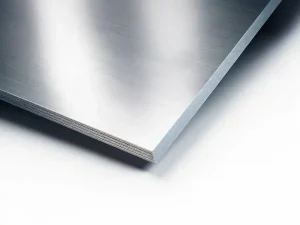
3003 aluminum sheet metal is known for its excellent formability and ease of processing. The main alloying element is manganese. It gives a moderate strength but outstanding ductility. These properties make 3003 aluminum sheets useful for sheet metal working operations. Good corrosion resistance makes the 3003 aluminum grade suitable for outdoor applications.
5052 Aluminum
5052 aluminum sheets offer excellent corrosion resistance even in marine environments. These aluminum sheets can accommodate tight bending radii. This excellent bending performance enables the production of complex shapes. Further, it offers impressive mechanical strength in a non-heat-treated condition. As a result, 5052 aluminum sheets are widely used in marine environments. Common applications include panels, fuel tanks, pressure vessels, electronic chassis, and automotive components.
6061 Aluminum
6061 aluminum is a very versatile alloy used in quite a lot of applications. It offers a balanced combination of strength, corrosion resistance, and machinability. But its formability is a bit less than that of 3003 and 5052 aluminum grades. 6061 aluminum is commonly used as thick aluminum sheets. 6061 aluminum is used in structural panels, brackets, frames, and base plates.
7075 Aluminum
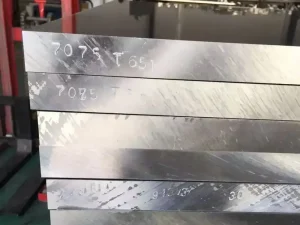
7075 aluminum grade offers the maximum mechanical strength. Its strength matches that of steel. Still, its density is a third of steel’s density. This high strength-to-weight ratio makes it ideal for high-stiffness applications. It is commonly used in aerospace structural panels, aircraft fittings, and defense components.
Aluminum Grades Comparison for Sheet Metal Fabrication
Generally, aluminum grade comparisons are based on factors such as corrosion resistance, mechanical strength, weldability, bendability, and machinability. The table draws a comparison between the different grades of aluminum:
| Grade | Alloy Type | Mechanical strength | Formability | Corrosion Resistance | Weldability | Machinability |
| 3003 | Al-Mn | Low -Moderate | Excellent | Good | Excellent | Good |
| 5052 | Al-Mg | Moderate | Very good | Excellent | Excellent | Good |
| 6061 | Al-Mg-Si | High | Moderate | Good | fair | Excellent |
| 7075 | Al-Zn (Heat treatable) | Very high | Limited | Moderate | Poor | Excellent |
Why Aluminum Temper Matters?
Temper matters a lot in metal fabrication processes for aluminum sheet metal. Temper defines the mechanical condition of the aluminum sheets. Two sheets made up of the same grade can differ in strength, hardness, and ductility. Commonly used suffixes for temper are given below:
| Suffix | Temper condition |
| O | Annealed |
| T4 | Naturally aged |
| T6 | Artificially aged |
| H | Non-heat treatable but cold worked |
For example, 6061-O grade would be more ductile than 6061-T4 or 6061-T6 grades. Another example is 5052-H. The ‘H’ suffix indicates that it is non-heat-treatable but cold-worked.
Aluminum Sheet Thickness and Sheet Metal Tolerances
Aluminum sheet thickness is measured in either SI units or imperial units. Another, older, and less reliable method is to measure it in BWG. Currently, most suppliers offer aluminum sheets in millimeter thicknesses. In the USA, people often use inches and mils. Anyways, these values are easily convertible. The chart can be used to convert BWG, inches, and mm values into each other. Another variation involves the use of terms to refer to the thickness range. For thickness above 6mm, the term ‘plate’ is used. For thickness below 0.15mm, the term ‘foil’ is used. What lies between them is called ‘sheet’.
| BWG | Inches (in) | Millimeters (mm) | Tolerances |
| 42 | 0.004 | 0.102 | ± 10% |
| 41 | 0.0048 | 0.122 | ±10% |
| 40 | 0.005 | 0.127 | ±10% |
| 39 | 0.0056 | 0.142 | ± 10% |
| 38 | 0.006 | 0.152 | ±10% |
| 37 | 0.0064 | 0.163 | ±10% |
| 36 | 0.007 | 0.178 | ±10% |
| 35 | 0.0076 | 0.193 | ±10% |
| 34 | 0.008 | 0.203 | ±10% |
| 33 | 0.0096 | 0.244 | ±10% |
| 32 | 0.01 | 0.254 | ±10% |
| 31 | 0.0116 | 0.295 | ±10% |
| 30 | 0.012 | 0.305 | ±10% |
| 29 | 0.0136 | 0.345 | ± 10% |
| 28 | 0.014 | 0.356 | ±10% |
| 27 | 0.016 | 0.406 | ±10 % |
| 26 | 0.018 | 0.457 | ±10% |
| 25 | 0.02 | 0.508 | ± 0.05 mm |
| 24 | 0.022 | 0.559 | ±0.05 mm |
| 23 | 0.024 | 0.61 | ±0.05 mm |
| 22 | 0.028 | 0.711 | ±0.05 mm |
| 21 | 0.032 | 0.813 | ±0.05 mm |
| 20 | 0.036 | 0.914 | ± 0.05 mm |
| 19 | 0.04 | 1.016 | ±0.05 mm |
| 18 | 0.048 | 1.219 | ±0.08 mm |
| 17 | 0.056 | 1.422 | ± 0.08 mm |
| 16 | 0.064 | 1.626 | ±0.08 mm |
| 15 | 0.072 | 1.829 | ± 0.12 mm |
| 14 | 0.08 | 2.032 | ±0.12 mm |
How to Choose the Right Aluminum Grade for Your Sheet Metal Part
Careful consideration should be given to selecting the most appropriate aluminum. In this section, some selection criteria are discussed.
Selection Based on Fabrication Method
Factors like ductility, bendability, weldability, and drawing behavior play a key role in fabrication. As an example, 3003 grade is suitable for deep drawing, while 6061 may not be. On the other hand, 6061 may be preferred more for machining than the 3003 alloy.
Environmental and Load Requirements
Alloys like 5052 can impressively withstand chemically aggressive environments. On the other hand, 7075 alloy has a very high load-bearing capability. Neither of these alloys can thus be interchangeably used.
Balancing Cost, Performance, and Availability
Sometimes, factors like cost, performance, and availability need to be balanced. 3003 is a general-purpose alloy with a moderate cost. It’ll be sufficient to be used in general applications. On the other hand, 5052 grade is more corrosion-resistant. But it is costly. So, it should only be used when required. Similarly, in moderate load applications, many common alloys can be used. But for ultra-high load, only the more expensive 7075 will serve the purpose.
FAQs
What is the difference between 3003 grade and 5052 aluminum sheets?
3003 grade has manganese as the main alloying element, while 5052 has magnesium. 3003 is used in general-purpose applications. 5052 grade is used in marine environments
How do I choose the right aluminum grade for my sheet metal part?
A careful study of the application requirements guides in selecting the correct grade.
Which organization gives guidelines for alloy grade comparison?
The Aluminum Association classifies aluminum alloys into series.
Which metalworking process is used to manufacture beverage cans?
Deep drawing is used to manufacture aluminum cans
Conclusion
Aluminum sheet metal is used in a lot of industries across the board. Each industry used some specific alloy grades depending on their application requirements. The Aluminum Association has designated an alloy series. It classifies alloys according to alloying additions. Acquaintance with these grades helps to pick the best one for a specific application.