
You will find steel everywhere around you, from household products to industrial equipment. The reason for its wide usability is its durability, strength, and reliability. But before using steel for any project, you must answer one question: how much steel actually weighs? If you don’t know the steel’s weight, it will create several problems later in transportation, metal fabrication, and cost issues. To prevent all this, a weight formula for steel comes into play. But if you are new to this term, it might feel technical. But worry not! In this guide, I will explain the different weight formulas for different steel shapes in the simplest terms. So let’s get started.
What Is the Weight Formula for Steel?

The weight formula for steel is used to calculate the weight of a piece of steel. This https://rapidfabricationservice.com/blog/weight-formula-for-steel/formula is based on three things. The first one is the steel’s size, which means its volume. Second is how dense the steel is, which means its density, and last is the final weight. In simple words, it tells you how much a steel object will weigh before you use or buy it.
The simplest weight formula for steel is:
Weight = Volume × Density
Here, the volume is the space steel takes. This volume varies with the shapes of the steel. For example, if there is a steel rod, pipe, bar, or sheet, each has a different volume calculation. Once you know the volume, you multiply it by the density of steel to get the final weight. The standard density of steel is usually taken to be 7,850 kg/m³. It means one cubic meter of steel weighs 7,850 kilograms.
Quick Highlight: This formula works for all types of steel, regardless of shape. The only thing that changes is how you calculate the volume. For example, a rectangular steel plate uses length × width × thickness, while a round bar uses a circular formula. But once you find the volume, the rest of the process is always the same. For your reference, I will discuss the different weight formulas for various steel shapes below.
Weight Formula for Steel Round Bars
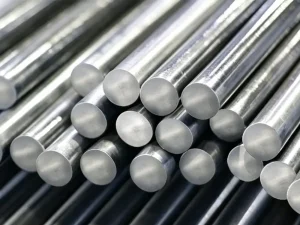
The weight formula for steel round bars is a way to calculate how heavy a cylindrical (round) steel rod is. For round steel bars, weight usually depends on the bar’s diameter and length. In other words, if you know how thick the steel bar is and how long it is, you can easily find its weight. The standard formula for a steel round bar is as follows.
Weight = (π × d² × L × ρ) / 4
Here,
- d = diameter of the bar
- L = length of the bar
- ρ (rho) = density of steel (usually 7,850 kg/m³)
This formula is based on the idea that a round bar is like a cylinder. First, you have to calculate the area of the circular cross-section (πd²/4). After that, multiply it by the length to get volume, and finally multiply by density to get weight. But now, for easier and faster calculations, engineers often use a shortcut formula:
Weight (kg) = (d × d × L) / 162
Here;
- d is in millimeters (mm)
- L is in meters (m)
- 162 is a constant used to convert the diameter to weight.
Now, let’s clarify it with an example. Let’s suppose you buy a round steel bar with a diameter of 12 mm and a length of 6 m. Now enter these two values into the shortcut formula above.
Weight of Round Steel Bar = (12 × 12 × 6) / 162 = 5.33 kg
Weight Formula for Steel Square Bars
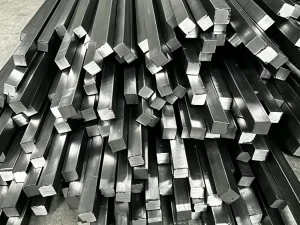
The weight formula for square steel bars is slightly different from that for round bars. The reason is that the square bar has a square cross-section. So first you have to find the area of the square (a × a). Then multiply it by the length to get volume, and finally multiply by density to get weight.
Generally, the weight formula for square steel bars is:
Weight = a × a × L × ρ
- a = side of the square bar
- L = length of the bar
- ρ (rho) = density of steel (7850 kg/m³)
Engineers also use another shortcut formula, which is:
Weight (kg) = (a × a × L) / 127.4
Here, 127.4 is the constant value that comes from combining the density of steel (7,850 kg/m³) with unit conversion (mm to meters).
Now, suppose you have a square stainless steel bar with one side measuring 20 mm and a length of 2 m. Put these values into the above shortcut formula.
Weight of square steel bar = (20 × 20 × 2) / 127.4 = 6.28 kg
Weight Formula for Steel Sheets/Plates & Flat Bars
Flat steel bars, sheets, and plates are rectangular in shape. Due to this shape variation, the weight calculation also varies. For their weight calculation, you will need three things: width, thickness, and length. That’s why you can use the following common formula for the weight calculation of steel flat bars, sheets, and plates.
Weight = Width × Thickness × Length × 7850
Now, if you have width in millimeters, thickness in millimeters, and length in meters, the shortcut will become.
Weight (kg) = (Width × Thickness × Length) / 127.4
Now, take an example: the width of a flat carbon steel bar is 50 mm. However, its thickness is 10 mm, and its length is 3 mm. Put all these values in the above formula.
Weight of flat steel bar, sheets & plates = (50 × 10 × 3) / 127.4 = 11.77 kg
Weight Formula For Steel Pipe
Steel pipes are cylindrical tubes. Unlike solid bars, a steel pipe has a hollow center. That’s why you have to calculate the weight by subtracting the inner hollow part from the outer part. In simple terms, you first have to find the weight of a full solid cylinder, then subtract the weight of the empty space inside it. The standard formula you can use to calculate steel pipe weight is.
Weight=π(R²−r²)×L×7850
Here
- R = outer radius (in meters or mm)
- r = inner radius
- Length = pipe length
7850 = density of steel (kg/m³)
But now, engineers also use another shortcut formula to calculate the weight of steel pipes. This formula saves time and reduces effort for several industries. This formula is as follows.
Weight (kg) = (OD − Thickness) × Thickness × Length × 0.02466
Here;
- OD = Outer diameter (mm)
- Thickness = wall thickness (mm)
- Length = meters (m)
If we solve an example using this shortcut formula, the results will be almost the same. So, suppose you have a steel pipe with an outer diameter of 50 mm. Its thickness is 5 mm, and its length is 6m. Put all these values in the above shortcut formula.
Weight of steel pipe = (50 − 5) × 5 × 6 × 0.02466 = 33.2 kg
Weight of Steel Beams and Structures
Calculating the weight of steel beams and structures is not as straightforward as that of other shapes. The reason is that steel beams are used in real buildings, and they come in different designs, sizes, and load conditions. How? For example, first, the shape and size of the beam play a major role. As you know, steel beams are not all the same. For example, you see some common types of I-beams and H-beams. Each of these shapes has a different cross-section.
It means they contain different amounts of steel, even though their lengths are the same. That’s why it’s possible for two beams of the same length to have different weights. After shape, the length of the steel beam directly affects its weight. Usually, a longer beam requires more steel, making it heavier.
So we can say that if the length increases, the weight also increases in the same proportion. Besides all this, the load acting on the steel beam or structure also matters, as does its weight. For steel structures, there are usually two loads: dead load and live load. Dead load is the permanent weight of the structure itself. However, live load includes temporary loads such as people, furniture, and vehicles, as well as wind.
Additionally, the weight of joints, bolts, nuts, welds, and plates also affects the overall weight of steel beams and structures. Calculating all these weights for the final weight of the steel structure is time-consuming and complex. That’s why engineers use standard engineering handbooks, weight tables, and computer software. These tools help them calculate the weight of steel beams and structures more accurately and quickly.
Steel Weight for Some Common Diameters: Quick Table
In real construction and fabrication work, speed and accuracy both matter. Right? But it is not always possible to calculate steel weight every time using formulas. That’s why engineers use pre-calculated standard values for different steel bar sizes. To make this easier, here is a table of commonly used diameter-wise weights.
| Diameter (mm) | Weight per meter (kg) |
| 6 mm | 0.222 kg |
| 8 mm | 0.395 kg |
| 10 mm | 0.617 kg |
| 12 mm | 0.888 kg |
| 16 mm | 1.58 kg |
| 20 mm | 2.47 kg |
How Does Steel Weight Calculation Help in Metal Fabrication?
The weight of steel is very important in metal cutting and fabrication. Before a fabricator starts cutting or shaping steel, they need to know how much the material weighs. This is important for many reasons. First of all, knowing the right weight of steel helps the fabricator choose the right cutting and shaping equipment. It also makes the work easier to organize.
Secondly, the weight of steel helps fabricators control project costs. Steel is often bought by weight. So knowing the required weight gives a better idea of the material cost. It helps workers order the right amount of steel. If they order too much, money and material will be wasted. If they order too little, the work will stop while waiting for more steel.
Lastly, the steel weight calculation helps workers move and transport fabricated parts in the right way. If there is lightweight steel, they know that it will be handled easily. However, because of the high weight of steel-fabricated parts, they have to use a forklift or crane. In this way, when workers know the weight, they can handle it properly.
Why Is Steel Weight Calculation Important?
After knowing the weight formulas for steel, you might wonder why it’s so important. Steel weight calculation is a very critical step in engineering, construction, and manufacturing. A slight mistake in steel weight calculation can result in an entire project failure. But that’s not all. Here, I will discuss some reasons that actually make the steel weight calculation important.
- Cost Estimation: The main reason steel weight calculation is important is its role in cost estimation. You might know that steel is usually bought and sold by weight, not just by size. If you know the total weight of steel required for your project, you can easily calculate the total cost. This preplanned cost estimation will save you money later.
- Structural Safety: Steel weight is directly linked to a structure’s safety. How? Actually, every building, bridge, or framework is designed to carry a certain load. If you do not correctly calculate steel weight, the structure will become either too weak or even collapse. So when you precalculate the steel’s weight, you ensure it can withstand the required load and pressure.
- Transportation Planning: Steel bars, structural beams, etc., are made at one place. They need to be transported to different sites for different projects. For transportation, their weight matters a lot. If you know the exact weight of steel, you can arrange the specific transport accordingly. Otherwise, it will be very difficult to handle it.
- Material Planning: Lastly, the steel weight calculation also supports material planning. In large projects, you must know how much steel will be needed to avoid shortages or waste. When you know the exact weight of steel, you can order the exact quantity of steel. This will reduce extra storage costs and prevent unnecessary leftover steel.
Conclusion
Steel is a widely used material worldwide. But for its fabrication, handling, transportation, and safety purposes, weight calculation becomes very important. Many beginners also get confused there. To eliminate this confusion, engineers use some standard formulas. Those formulas vary due to the shapes of the steel.
That’s why I have discussed each formula separately with its explanation. Remember, the right weight calculation for steel is very critical before you start any projects. It will help you estimate the total cost, transportation, safety, and material planning. Without knowing the exact weight of steel, the entire project might fail.