
Stainless steel is preferred due to its excellent durability and corrosion resistance. From automobiles to aerospace and construction, this steel type dominates every sector. However, welding stainless steel is not as easy as welding most other metals. This raises a question: Why is welding stainless steel difficult?
There is not a single reason that makes its welding difficult. Mainly, the properties of stainless steel are less favourable for the welding process. As a result, welders, especially beginners, often end up blowing holes or making weak welds on these materials. In this article, I’ll discuss the challenges of welding stainless steel and offer practical tips.
What Makes Stainless Steel Special?

There are different types of steel available. Each of those types differs in terms of composition. Among them, stainless steel stands out for its higher chromium content (over 10.5%). This chromium makes these steel types very special by increasing their corrosion resistance. Other types, such as carbon steel, don’t contain chromium.
So, those types are not particularly corrosion-resistant. Wondering how chromium increases the corrosion resistance of stainless steel? That’s because of the chromium oxide layer. When stainless steel comes into contact with moisture, the chromium reacts with oxygen. This reaction forms an oxide layer, known as chromium oxide (Cr₂O₃).
This layer remains on the surface of stainless steel but is invisible. When stainless steel is under stress, this layer prevents moisture from reaching the stainless steel surface. In this way, it protects this material from corroding. What I like about this chromium oxide layer is that it can heal itself. If stainless steel is scratched, rubbed, or otherwise damaged, it can still regain this layer.
Why is Welding Stainless Steel Difficult?
First things first – is stainless really hard to weld? Yes. In fact, many welders struggle to make strong welds on the surfaces of these steel types. However, understanding why stainless steel is hard to weld is crucial. It will help you avoid poor welds on stainless steel that don’t last. Let’s drill down and discuss the key reasons that make stainless steel difficult to weld.
1- Stainless Steel Retains Heat
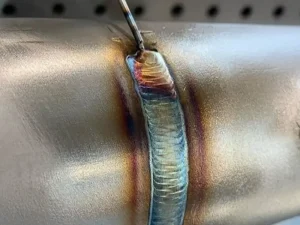
Stainless steel has low thermal conductivity. Due to this, the heat transfer (moving) in this material is very slow. When you weld this material, the heat stays on one spot. However, the heat spreads poorly across the surface, resulting in a buildup in one place. That specific spot gets more heat, and causing excessive melting in that spot.
This spot will eventually get damaged and create a hole. In other materials, such as aluminum, when you weld, the heat penetrates the surface material and spreads evenly. In this way, there is less heat in one spot, so no hole forms. For tackling this issue, I recommend using a welder with very low amperage. It will help by reducing heat at the welding spot, preventing it from blowing holes.
2- High Thermal Expansion
Stainless steel has higher thermal expansion, which is another significant drawback. Thermal expansion means that this material expands when heated. Similarly, it contracts or shrinks, and the temperature drops as it cools. When you weld stainless steel, it expands rapidly due to heat exposure.
This expansion is fine, but when you remove the welder, the temperature goes down. At this point, the stainless steel starts to shrink. These expansions and contractions are bad for welding, as you’ll face distortion and warping in the weld. Confused why warping is bad for welding? Welds on stainless steel can warp and become weak, looking awful.
Welders use tack welding on stainless pieces before final welding. This minimizes the risk of warping when parts are exposed to high and low temperatures at different times. Remember, welding stainless steel requires patience from the welder. A quick approach can result in a weaker weld with a bad appearance. This thermal expansion can be a headache, especially when you weld thin stainless sheets.
3- Heat Tint and Discoloration Form Easily
Have you ever seen colored layers on a weld spot on stainless steel material? This colored layer, called a heat tint, is caused by the reaction of stainless steel with oxygen. During welding, this metal is exposed to very high temperatures. At this temperature, stainless steel becomes active, reacting with oxygen and making colored layers.
Those colors can be either blue, yellowish brown, or gold, making the weld look less visually appealing. Additionally, these heat tints can also affect the chromium oxide layer’s significant corrosion resistance. As a result, this material becomes prone to corrosion, especially in moist conditions. You can prevent this heat-tint or discoloration issue by using the right shielding gas, i.e., a mixture of argon and CO2.
4- Sensitization & Compromise on Corrosion Resistance
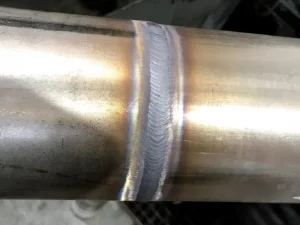
Sensitization can be another headache you may encounter during stainless steel welding. When we weld stainless steel, temperatures increase at the weld spot (rising to 850°C). Due to this, the chromium carbides are formed by the reaction between chromium and carbon. As a result, the chromium content in the stainless steel is depleted by the formation of chromium carbide.
Low chromium content simply means the stainless steel is more prone to corrosion. As I said earlier, chromium is the main ingredient that makes stainless steel corrosion-resistant. As a result, the use of stainless steel has become less effective, especially for marine parts. This issue is more common in stainless steel with a higher carbon proportion and vice versa.
5- Larger Heat-Affected Zone (HAZ)
The heat-affected zone in stainless steel is generally larger than in the other metals. The reason relates to the low thermal conductivity that I mentioned above. During welding, the heat does not spread quickly and remains at a single spot. That specific place or spot becomes affected by the heat.
If heat spread were faster, there would be less heat buildup in a single spot, resulting in a shorter HAZ. What’s the disadvantage of a larger HAZ? The heat-affected area is less corrosion-resistant. As a result, the metal piece will corrode quickly in salty or moist conditions. It would reduce the durability and performance of the stainless steel.
6- Precise Heat Input and Welding Parameters
Most beginners find stainless steel welding very challenging. That’s because stainless steel requires precise inputs to achieve strong welds. Small mistakes can lead to distorted or warped welds. Each parameter, such as heat, amperage, voltage, and travel speed, must be carefully adjusted. Suppose you weld stainless steel at a higher temperature.
This will cause the material to burn through and form surface holes due to its low thermal conductivity. Similarly, the slower travel speed of the torch can also be harmful to the weld quality. However, experienced welders understand these parameters and use them appropriately. As a result, they can weld with precision using this stainless steel.
7- Weld Pool Control & Back Purging
During welding, the stainless steel melts due to the very high temperatures. This molten stainless steel is fused with filler metal to make a weld. However, when stainless steel is molten, it moves more quickly. This molten material, called a weld pool, can be challenging to keep in one spot. You should feed the filler material slowly to keep the weld pool under control.
If the molten stainless steel flows quickly, you will see the weld spread out, making it look ugly. Sometimes, the backside of a stainless steel weld gets oxidized. As a result, oxidation can lead to heat tints. For this, welders use backpurging techniques. In this method, they fill the backside of the weld with argon to prevent issues.
8- Higher Cost of Welding
Making a weld on stainless steel requires utmost care and precision. A slight mistake can result in a poor weld with little or no strength. Setting up the right parameters is crucial. Slightly higher or lower than usual, any of those parameters can affect the weld’s quality. Additionally, you’ll need filler material, shielding gas, purging gas, and so on.
These items further increase the cost of stainless steel welding. The welder must also have some experience welding before creating a weld on stainless steel. Experienced welders can charge more if you’re looking to have someone weld stainless material. All these factors add up to the less favorable nature of welding stainless steel. This is more about cost than technical welding difficulty.
Frequently Asked Questions
What are the challenges of welding stainless steel?
Common challenges you may face during welding stainless steel include:
- Warping and distortion
- Intense heat buildup at one spot
- Heat tint and discoloration issues
- A larger heat-affected zone affects corrosion resistance
Can stainless steel be welded easily?
Yes, stainless steel can be welded. However, it is not easy to weld as many other materials as aluminum. Welders must have expertise and skills to produce a strong, reliable weld.
What’s harder to weld, stainless or aluminum?
I consider stainless steel a challenge to weld. Its low thermal conductivity and higher thermal expansion cause serious challenges. Welding aluminum is relatively easier than welding stainless steel.
Conclusion
Is it possible to create a reliable weld on stainless steel? Is it possible to weld stainless steel pieces? The answer is yes. You can weld stainless steel, but you’ll have to be careful. This material is not among the easiest to weld. Instead, the welders can face serious setbacks during welding.
Slight mistakes can make the weld weaker, and even cause the burning through on stainless steel. In this article, I’ve discussed key reasons why it’s hard to weld on these steel types. You must carefully understand each type and prevent that specific problem. If you have the proper knowledge and expertise, you can handle this welding process effectively.