
Welding helps join two metal pieces regardless of their thickness. However, welding the thin metal sheets is generally more difficult than welding on thicker ones. Right? You’re more likely to experience burn-through. This raises a question: How do you weld thin metal without burning through?
This burn-through issue during welding can be disastrous, especially when the margin of error is small. Therefore, learning the proper way to weld thin metal pieces is crucial. In this article, I will discuss the step-by-step process to help with welding and prevent burn-through. We will also learn about what causes burn-through during welding. So, let’s begin!
Overview of Thin Metal & Burn Through

Metals come in different thicknesses and are used to make various parts. Remember, metals with a thickness of around 0.6 mm to 2 mm are considered thin metals. Such metal sheets are used to make roof panels and multiple automotive parts. These metals are thinner and less strong, but lighter, which makes them stand out.
These metals can be made of any material. For example, you’ll see thin pieces of stainless steel, aluminum, brass, and so on. Are thin sheets of any material hard to weld? The answer is YES. Welding thin metal sheets (of any material) can be difficult, as you may encounter burn-through.
But what is the burn-through issue in metal sheet welding? Burn-through is a problem caused when intense heat during welding creates holes in metal pieces. This happens because the metal sheets are thin. So, the heat from welding does not distribute evenly throughout the metal sheet, causing a hole. In simple terms, a metal piece has a small mass, which limits its ability to absorb heat, resulting in burn-through.
This burn-through can be very dangerous if you’re creating a weld on metals that are precious. If you make holes in them instead of welding, it means those pieces are now useless. To tackle these issues, you’ll need to control heat during welding to prevent burn-through. Is burn preventable?Yes, 100 % — but only with the right technique.
How to Weld Thin Metal Without Burning Through? Practical Tips
Burn-through should always be avoided for the best welding results. You should prevent it even if the metal sheets you’re welding are very thin. In the section below, I’ll discuss some steps to help prevent burn-through when welding thin metals.
1- Low Heat Settings & Higher Travel Speed
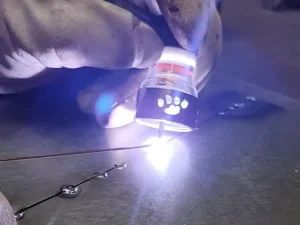
First, I recommend keeping the welder’s power low when handling thin metal pieces. You should start with the lowest power your welders offer. Start low. If you’re not getting proper fusion, you can gradually increase the power. Lower power means less heat at the weld spot, preventing overheating and melting of metal pieces.
15 or 16 volts of power for welding should be enough for welding thin metal sheets. You can adjust the power depending on real conditions during welding. Secondly, you should move the welding torch quickly and not stay at one spot for long. If you keep the heat focused on a single place on a thin sheet, it will melt that spot. Eventually, you’ll end up with holes (burn-through).
2- Apply Stitch Welding
Many welders ignore stitch welding, but it can be beneficial, especially in welding thin metal pieces. Stitch welding involves creating a small weld for a second, then stopping the weld. Skip forward and lay another short bead a little distance away. In this way, you can create 4 to 6 welds, depending on their size.
Once done, you can fill the gap between these already-made welds. I consider this valuable technique because it allows the weld spot to cool when you stop. So, heat cannot really melt the whole piece and create a hole. In simple words, welding and then stopping at a spot allows cooling, preventing heat buildup.
3- Use Tack Welding Technique
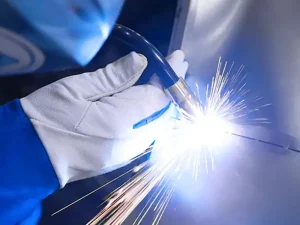
Using tack welding before creating a strong, big weld can be helpful. Remember, the thin metals cannot withstand sudden heat shock. If the sheet is cold and you apply heat to it, it can shock, causing intense heat to create a hole. So, I recommend making very small dot welds on the joint before starting welding.
These small dots at regular intervals (distance) will keep the pieces together. They also help the metal warm up gradually and reduce warping for stitch welding. After tack welding, you can create a bigger weld with controlled heat. This will ensure that thin metal pieces can withstand heat better and don’t cause burn-through.
4- Proper Torch Angle & Control Arc Length
You should use the right torch angle if you want to make a strong weld on thin metals. For example, if you keep the torch straight downward, the heat will focus on a single spot. As a result, that spot will melt and form a burn-through (hole). I highly recommend keeping the torch downward, but tilt it slightly 10–15° forward.
This will ensure heat doesn’t focus on a single spot and gets distributed. Along with the right torch angle, using the right arc length also gives you the right amount of heat control. I consider a shorter arc length suitable for welding on thin metal pieces. If the arc length is less than 6mm or greater than 14mm, it can be bad for welding. Wondering why arc length matters in welding?
A long arc is weaker and produces less heat. As a result, less heat reaches the weld spot, resulting in a weaker weld. On the other hand, an extremely short arc is also bad. The reason is that the shorter arc has very high power. As a result, more heat reaches the weld spot, which can create holes in thin metal and cause burn-through.
5- Choose the Right Shielding Gas
The right shielding gas is an essential factor in controlling burning issues. Remember, the shielding gas directly affects the arc’s behavior. For example, if you use 100 % CO₂ as shielding gas, it will sharpen, narrow, and intensify the electric arc. The arc will be more digging instead of staying on the surface of the metal.
As a result, this arc will dig into the metal piece (spot) and create a hole. On the other hand, using argon, or a mixture of argon and CO₂, makes the electric arc a bit wider and more floaty. As a result, the arc does not dig into the metal and remains on the surface. In this way, it prevents the burn-through issue on the thin metal pieces.
The shielding gas you should use depends on the type of material you’re welding. For example, 75% of argon and 25% of CO₂ (mixture) is common when welding mild steel. Similarly, 100 % argon is excellent for aluminum (thick or thin). You should analyze the type of metal you’re using and then decide on the shielding gas.
6- Clean the Surface Before Welding
If the surface of the metal to be welded is unclean, this can pose a serious issue during welding. Sometimes, the metal surface can get rust, paint, or other coatings. These contaminants can cause the arc to be uncontrolled. So, this arc can move, jump, and dig in the metal to create a hole. Thin metal won’t be able to withstand the jumping arc.
Therefore, it is essential to perfectly clean the surface of metal pieces. You can use grinders to remove sticky coatings and other dirt. If you don’t have a grinder, using a wire wheel can help in cleaning the surface of a metal piece. Remember, a smooth surface helps with welding, whether your metal pieces are thin or thick.
7- Choose the Right Size (Thickness) of Wire
During welding, a wire is generally used as an electrode. This wire is fed into the weld, melted, and fused with metal pieces to create the weld. If this wire size is large or the wire is thicker, it can cause burn-through at the weld spot. The reason is that a thicker wire requires more heat to melt. This higher heat will be applied to the weld spot and can melt the metal pieces.
Due to extreme melting, metal pieces can experience burning through. I recommend using a thin wire when welding thin metal pieces. Suppose the piece you weld has a thickness of 1.0 mm, then the wire you choose should be around 0.6 mm in thickness (size). Similarly, if the metal pieces are 2 mm thick, a 0.8 mm wire will work fine.
Quick Highlight: Slightly up or down, like 0.7mm or 0.9 mm, is acceptable. But using a wire that is way too thick for the metal piece is a bad idea. The simple rule is: you should use a wire slightly thinner than the metal pieces to be welded. If the wire is thicker than the metal pieces to be welded, you’ll face issues such as burn-through and more.
Frequently Asked Questions
Which welding type to use for welding thin metal?
Both TIG and MIG welding types can be used in this regard. I recommend TIG welding, especially if you want precision on thin metal. However, you can also use MIG welding, especially the short-circuit MIG type.
Can beginners weld thin metal?
Yes. Welding thin metal undoubtedly requires care and precision. You can create a weld on thin metal by following the tips and guidelines above. However, I don’t recommend doing it if you’ve never welded before.
Why does my thin metal keep blowing holes?
The reason is that thin metals absorb less heat. Why? That’s because thin metal has very little mass to absorb and dissipate heat. Thin metals have no solid material inside that could distribute the heat. As a result, heat enters, melting it and creating a hole.
Conclusion
Thin metals are not impossible to weld. No matter if thin metal is aluminum, steel, or brass, welding it is doable. However, you cannot use the same strategy you use for welding thicker metals. The reason is that thin metals are prone to deterioration, especially when exposed to high temperatures. One of the major issues you’ll face is blowing holes through thin metals. There are a few things you must consider to avoid burn-through issues in metal parts. This article provides actionable steps to help you avoid burning through.