
Material thickness is a crucial parameter in metal fabrication. If the part is thinner, it might be more fragile; conversely, a thicker part might be more robust. Manufacturers carefully consider thickness when fabricating metal sheets. That’s why a guide on material thickness is very important, especially if you’re looking for a fabrication service.
Not only during fabrication, but keeping thickness in mind while designing parts is equally important. Interestingly, many people get confused when their thickness is written in different units. These include millimeters, inches, and gauges. However, this article dispels any confusion and discusses the material thickness in detail.
What is Material Thickness in Sheet Metal Fabrication?

Thickness simply means how thick the material is. A higher thickness means the material has more mass, is heavier, and is stronger. Cutting, bending, and forming thicker materials can be more difficult. Material thickness is generally expressed in three units: mm, inches, and gauges.
In metal fabrication, the material thickness is fundamental. As you know, the metal fabrication process involves different techniques. These include cutting, bending, welding, forming, and more. The ease of each of these metal fabrication techniques varies depending on the thickness of the metal sheets.
If the sheet is thicker, cutting, bending, or forming it becomes more difficult. The cutting tools have to apply more force to cut or shape the sheets. Interestingly, there are three units used for showing material thickness. Millimeters are the most common unit worldwide, except primarily in the United States. An inch is an imperial unit commonly used in the USA.
In other words, inches and millimeters indicate thickness but are used in different regions. If you’re in the USA, you’ll see the sheet’s thickness written in inches. Gauge is another method for showing the thickness of metal sheets. Interestingly, a lower gauge number indicates a higher thickness. Similarly, the higher the gauge numbers, the lower the sheet thickness.
For example, stainless steel sheets with a gauge of 10 will be thicker than the same material with a gauge of 20. To know the exact thickness, you’ll have to refer to a gauge chart for the specific metal. Why? That’s because each metal has a different thickness, measured by gauge numbers. Gauge 10 in aluminum and stainless steel will show different thicknesses.
Sheet Metal Thickness Categories
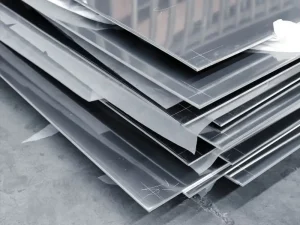
When it comes to thickness, the metal sheets are divided into three categories. These include:
- Thin metal sheets
- Medium-thickness sheets
- Thick Metal Sheets
Thin metal sheets are generally weak and have limited strength. Their thickness ranges between 0.2 mm and 2 mm. Remember, the thinner the metal sheets are, the weaker and more fragile they become. Therefore, these sheets are used in making lightweight automotive panels and HVAC systems. In these applications, these sheets do not face high loads.
Metal sheets with medium thickness are more reliable than thin sheets. Their thickness ranges from 2 mm to 6 mm, and they are slightly more expensive than thin sheets. In their application, these sheets are preferred in the furniture industry. Fabricating sheets with medium thickness is more difficult than fabricating the thin sheets.
Thicker sheets start from 6 mm and are very durable. They can withstand heavy loads efficiently and are very reliable. Such sheets are preferred for the manufacture of a wide range of heavy-duty parts and products. Thick sheets have no flexibility and are very difficult to cut and fabricate. The cutting machines have to put extra effort into their fabrications.
Apart from this, the cost of these sheets is also higher. Fabricators still use thick metal sheets because they provide excellent strength. Remember, each of these metal sheet thicknesses has its pros and cons. You should choose the metal sheet thickness after analyzing your needs. If you prefer flexibility, choose thin sheets. However, for strength and rigidity, I recommend choosing medium- to thick-metal sheets.
Importance of Thickness in Sheet Metal Fabrication
One thing that can be confusing is “Why sheet metal thickness matters?” Interestingly, without considering the thickness of metal sheets, fabrication processes can be incomplete. I will discuss the importance of sheet metal thickness in the section below.
1- Load Bearing Capacity (Strength)
First, the thickness of materials indirectly indicates their strength. If a metal sheet is thicker and stronger, its load-bearing capacity is also higher. All these parameters are directly linked to each other. For example, you have a 1 mm-thick steel sheet (in the thin sheet category).
This steel sheet will bend when exposed to a weight of 15 to 20 kg. On the other hand, a 6 mm steel sheet can withstand a load of 100 kg. So when manufacturers make parts to withstand high loads, they prefer thicker sheets and vice versa. In other words, thickness helps decide how strong a material is.
2- Weight & Flexibility
Material thickness also helps in identifying both its weight and flexibility. There are some applications where sheets must be flexible and lightweight. In such cases, manufacturers use thin metal sheets. On the other hand, when parts need to be heavier and more rigid, thicker sheets are preferred. This means knowing the thickness of the metal sheets helps in choosing the right combination of weight and flexibility.
3- Cost Implications & Fabrication Processes
As I said above, thin metal sheets are affordable. In contrast, thicker sheets are more expensive. Why? This is because sheets with more thickness have higher material costs. This results in higher weight and cost. When manufacturers aim to keep costs down, they often compromise on strength and choose thin sheets.
Not only cost, but also understanding of metal sheet thickness matters in metal fabrication. Remember, fabrication involves different techniques such as cutting, bending, punching, and more. If a sheet is thicker, its bending, cutting, and forming would be difficult and costly. On the other hand, thin or medium-thickness sheets are easy to cut and fabricate. Manufacturers consider thickness when deciding whether a specific sheet is easy to fabricate.
Remember, all sheet thicknesses can be fabricated in one way or another. However, their ease of fabrication differs with thickness. If the sheet is thicker, tools would use more power to cut it. During the process, wear-out or overheating of tools is also common. Therefore, fabricators measure sheet thickness to assess the ease of fabrication.
Key Factors to Choose the Right Material Thickness
Choosing the right material thickness is crucial. One wrong step in material thickness can lead to imperfect parts. For example, imagine you’re making a part to withstand the higher load. However, you choose a sheet with less thickness. This part won’t work and may bend under heavy force. There are many factors to consider when choosing material thickness. Some of these are as follows:
1- Product Requirements (Strength vs Weight)
You should always consider product requirements before choosing any metal sheet thickness. Different products have different requirements. For example, products need to be robust, heavier, and stronger. In such a case, you’ll have to choose thicker metal sheets.
Parts made with thicker sheets will have better structural integrity. On the flip side, your product might require flexibility, lightweight, and portability. In such a case, thin metal sheets are the best option. Considering the product’s requirements is the best way to choose the right sheet thickness.
2- Type of Material Being Used
In metal fabrication, a wide range of materials are used, right? These include stainless steel, aluminum, copper, zinc, and more. The properties of these individual metals also affect how much thickness in that material you should choose. For example, stainless steel is a very strong, durable material. If you’re using stainless steel, you can compromise thickness and choose thinner sheets.
It will offer excellent strength, as stainless steel is inherently strong. On the other hand, using aluminum requires a thicker sheet. The reason is that aluminum itself is weaker. If you use a thin sheet of aluminum, it would be too weak, reducing the parts’ load-bearing capacity. In such a case, you’ll need to use a thicker aluminum sheet to ensure the parts achieve optimal strength. This applies to all materials, and you must consider their type when choosing thickness.
3- Bend Radii & Formability
Materials’ bending radii and formability are also crucial factors. Bend radius refers to the angle or curve when a material is bent. Formability indicates how well a material can be bent and shaped. Thin metal sheets are easy to bend with a smaller bend radius. In contrast, thick sheets are more difficult to bend. When bent, their bend radii will be larger.
If you try to reduce bend radii, you might get the materials to crack or distort. Suppose you have metal sheets of 2 mm and 5 mm. You bend both of these sheets at a 90-degree angle. The curve produced by bending will be higher on 5 mm sheets. I recommend choosing thin sheets if you require less bend radius when bending or shaping parts.
4- Choose Thickness Based on Machine Capacity
As I said above, ease of fabrication varies with a change in metal sheet thickness. This holds for all the metal fabrication techniques. For example, cutting a 2 mm sheet is very easy and less time-consuming than cutting a 7 mm sheet. Additionally, thin sheets can be fabricated with simple machines. If you have a less powerful machine, you should consider these metal sheets. Why? The less powerful machines will cut these thin sheets easily. On the other hand, if you have larger machines, using thick metal sheets makes sense.
5- Fastening & Joining Method
Which fastening method will you use to make the specific parts? If you plan to use threaded holes and bolts, you should choose sheets with higher thickness. The reason is that a higher thickness will give you more space where the thread can be made. The bolt will firmly seat on those threads and join the pieces.
If you aim to use rivets or weld the parts, you can choose a sheet with low thickness. Remember, if you thread a hole and bolt a thinner sheet on, the bolt may loosen or pull out over time. Fastening is a crucial step in metal fabrication. So you must consider it when choosing the thickness to avoid a loose connection later.
6- Tolerance & Durability Expectations
Imagine you have made two pieces that will fit or assembled. In such a case, you should check the tolerances of both pieces. This will tell you the acceptable thickness variation between two parts. If you make one part thin and the other a bit thicker, the parts won’t fit together. Therefore, I highly recommend always considering tolerance when making parts.
Ideally, a thickness tolerance of +/- 0.002″ works fine in most metal fabrication processes. Some products are short-term and require no specific durability. In such cases, inexpensive thin metal sheets work best. You can make the parts more quickly and within an affordable budget. However, some products are designed to remain in good condition for years to come. In such a case, you should prefer thicker sheets as they are stronger and more durable.
7- Surface Finish & Aesthetics
Choosing the right material thickness also influences the surface finish and aesthetics. You’ll see that many decorative products are made with thin material. Why? The reason is that thin sheets offer better visual appeal, surface finishing, and a sleek look.
On the other hand, thicker sheets look less visually attractive. However, they are ideal if you want more durability, strength, and reliability. It depends on the type of product you’re making. For decorative ones, go with thin sheets. However, if it is parts with demanding functionality, you should stick to thicker metal sheets.
8- Cost of Your Project
One of the fundamental factors influencing the selection of material thickness is cost. Different projects have different budgets, and you have to align with each project’s specific budget. Suppose you’re making a product, but the budget is tight. In such a case, you can use a thinner metal sheet. Although it would reduce strength, it saves you some bucks and helps you make basic products.
Conversely, if there is no budget constraint, you should choose material with greater thickness. This will ensure your product is very durable, stronger, and long-lasting. If your customer demands post-processing on sheets, e.g., embossing or texturing, this makes the selection trickier. In such a case, I favor thin sheets. The reason is that embossing or coating on thin metal sheets looks more practical and attractive.
Conclusion
Let’s conclude: material thickness plays a key role at every stage of product development. From designing to manufacturing and post-processing, the right thickness ensures better quality. Interestingly, deciding which thickness to choose can be very tricky, especially if you’re a newbie. However, this article explains thickness and its selection process. Each product and project has different requirements. So they need materials of different thickness. However, some factors can help decide the right thickness for your product.