
Welding sheet metal has become a popular method among several industries. For example, it is common in the automotive, construction, and manufacturing industries. But welding sheet metal is not like welding other thick metals, as sheet metal is very thin and delicate. So beginners often get confused about choosing the right welding method for metal sheets. That’s where this guide to different methods of welding sheet metal will help.
Actually, welding sheet metal is the process of joining two metal sheets using heat or pressure. However, a metal sheet is usually thin. That’s why not every welding technique can handle these sheets; they might burn, bend, or get damaged. To prevent these issues, this guide discusses methods for welding sheets you can choose from. So let’s get started.
Common Methods of Welding Sheet Metal
When working with metal sheets, you will realize that they vary greatly from ordinary metals. These sheets are very thin and heat-sensitive. That’s why some special welding techniques are used in sheet metal fabrication. Before you get started, know the welding methods and choose the most reliable one.
1- MIG Welding (Metal Inert Gas Welding)

The easiest welding method for metal sheets is MIG. This method basically joins two metal sheets using heat and a special wire. How? Let me explain. Actually, in this method, a machine pushes a thin metal wire through a welding gun. When you press the trigger, an electric spark (called an arc) is created between the wire and the metal.
This heat is so strong that it melts both the wire and the edge of the metal pieces. This melted wire now also acts as filler. It means it fills the gap and joins the two metal pieces together. At the same time, a shielding gas also flows around the weld area. This gas is usually argon, which protects the weld from air. Why? Because during welding, air can weaken the weld and cause defects.
What makes MIG stand out is its automatic and continuous nature. You don’t have to add fillers manually; a welding gun does it automatically. This automation helps you weld metal sheets quickly and effectively when you need to meet tight deadlines. But remember: when working with MIG, you must maintain full control of the heat. A slightly high heat can burn the sheet. So it is best to work in short bursts using low heat.
2- TIG Welding (Tungsten Inert Gas Welding)
TIG welding is another method used for very clean, precise, high-quality welds. What makes it different from MIG is its control over heat. How? In TIG welding, the machine uses a foot pedal. So, welders can adjust the heat intensity based on the sheet metal thickness. Actually, in TIG, you use a non-consumable tungsten electrode that creates the arc.
This arc produces intense heat that melts the sheet metal at the joint. On cooling, it creates a strong weld that doesn’t break quickly. But in TIG, there is no automatic filler-supplying system like in MIG. Here, you have to add the filler manually. You have to carefully control the torch with one hand and feed the filler with the other. This makes TIG both flexible and highly skill-based.
3- Stick Welding (Shielded Metal Arc Welding)
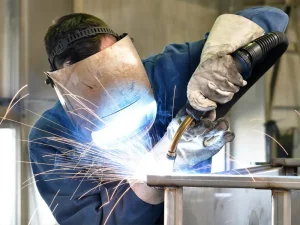
The most traditional method for welding sheets has been stick welding for centuries. It gets its name from the use of a stick-like electrode to create the weld. When you turn on the welding machine, it creates an electric current that flows through the electrode or stick.
Now, when this electrode touches the metal sheet, it produces a strong electric arc. This arc is what generates the heat that melts both the metal surface and the electrode tip. As they melt, they form a strong joint. Once it has cooled down, it creates a strong weld on the metal sheet. One unique feature of this welding method is that its electrode is coated with a special material called flux.
The flux actually performs two tasks. First, it creates a protective gas, and second, it forms a protective layer called slag on the weld. This layer prevents the weld from weakening due to air until it cools. However, once the weld is strong, you must clean that slag for a smooth weld on a metal sheet.
Quick Highlight: No doubt, stick welding is a safe and efficient welding method. However, today, it is not considered the best choice for metal sheets. The reason lies in its intense heat production. It produces very high heat that is difficult to control. As the metal sheet is thin, this uncontrolled heat can burn through it. So professionals often don’t recommend this method for metal sheets.
4- Spot Welding
Spot welding is another fast and simple method for welding sheets, especially when working in mass production. In other welding methods, you can see that they produce long, continuous welds. Right? However, that is not the case with spot welding. It joins metal sheets at specific points or “spots,” which is how it gets its name.
In this method, two metal sheets are placed on top of each other. Then, a machine with two metal tips (called electrodes) presses the sheets together very tightly. Now electricity is passed through these two electrodes. This electricity generates intense heat at a single point (the spot where the sheets touch).
This heat is so strong that it melts a tiny area of both metal sheets at that point. On cooling, a strong and durable weld is produced that lasts longer. All this makes spot welding very quick and reliable for mass production. But remember, it only works when two metal sheets are overlapping, and it cannot create long, continuous joints.
5- Flux-Cored Arc Welding (FCAW)
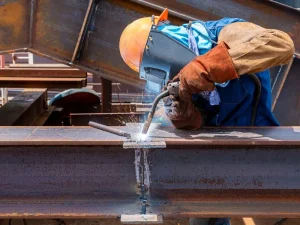
Now, another welding technique is flux-cored welding. It is somewhat similar to MIG welding, but the only difference lies in the wire used. How? Actually, in FCAW, a special wire with a flux material inside is used instead of a solid wire. That flux plays a crucial role. First, the welding machine feeds this flux-filled wire through the welding gun.
Now, when the flux wire touches the metal and creates an electric arc, it produces high heat. This heat melts both the wire and the base metal, allowing them to join together. But at the same time, the flux inside the wire starts to play its role. As it burns, the flux creates protective gas and a layer of slag. Both of these prevent the weld from damage caused by air during cooling.
It means you can use this welding method for sheet metal in both indoor and outdoor (windy) conditions. The flux wire will protect the weld in outdoor conditions. However, proper control of heat is crucial in the welding method. The high heat can quickly damage the metal sheet, potentially causing it to burn.
6- Laser Welding
The most advanced, precise, and modern method for welding sheet metal is laser welding. Unlike traditional welding, it does not use any electric arc. Instead, this method uses a very intense, highly concentrated laser beam. When this laser beam hits a very small area of the metal sheet, it quickly melts the metal at the joint.
Once the metal melts, the two pieces fuse. Now, as that area cools, it forms a strong, smooth joint. Laser welding doesn’t even need filler material, as the laser itself is so powerful that it is enough to join the metal directly. Moreover, this welding method is very precise and has a very small heat-affected zone (HAZ). This is the area surrounding the weld that is affected during welding.
Laser welding has a small HAZ, meaning only a tiny area around the weld is heated. The surrounding metal sheet area remains unaffected. Moreover, laser welding machines are often CNC-controlled, similar to laser cutting. These machines ensure accuracy and create identical welds. That’s why it has become very popular among modern fabrication industries.
7- Plasma Arc Welding
Lastly, plasma arc welding for sheet metal is similar to TIG. However, here the heat produced to melt the metal sheet is stronger and more concentrated. Why? This is because of plasma. Let’s understand this method from the start.
First of all, a welding machine creates an electric spark inside a special torch. At the same time, a gas (usually argon) is pushed through a very small opening inside the torch. When the gas passes through this tiny space and encounters an electric field, it becomes plasma. Plasma is basically a super-hot, powerful stream of energy.
This plasma comes out as a very narrow jet and is directed exactly to the point where two metal pieces meet. The heat is so intense that it melts only the small area where the metal sheets join. Now, when the heat is very focused (not spread out), only a small area gets heated. It reduces damage to nearby metal and creates a strong weld.
Factors to Think About Before You Choose a Welding Sheet Method
You can see that all the above sheet metal welding methods vary in terms of usability and operation. That’s why it’s crucial to choose the right method that matches your sheet metal and project type. Remember, choosing the wrong welding method not only causes sheet damage but also wastes time. Before you choose a welding method, consider these factors.
-
Metal Sheet Thickness
The thickness of the metal sheets varies. Right? First, determine the thickness of your metal sheet, then choose the welding method. Suppose your metal sheet is very thin. In this case, you should choose a welding method that produces less heat, such as MIG. For somewhat thick sheets, you can choose stick or TIG.
-
Type of Metal
Metal sheets can be made from different types of metals. So, in the second point, you need to know which metal type you are using, as each behaves differently when heated. For example, if your metal sheets are made of aluminum or stainless steel, you have to be very careful. For these metals, you must use low-heat, precise welding methods such as laser welding.
-
Heat Control
Heat control is the most crucial factor in metal sheet welding, especially for beginners. As you know, sheet metal is very thin. So a slightly higher heat can burn and cause warping. Therefore, you must choose a welding method that provides full heat control. For this, I suggest choosing TIG and laser welding.
-
Your skill level
Next, your welding skills and experience also matter. If you are new to welding, you must choose beginner-friendly techniques such as MIG. The reason is that these welding methods are generally easier to use. However, TIG and other techniques require experience and focus. Once you have experience, you can then use complex welding processes.
-
Project Budget
Lastly, when choosing the welding sheet method, also consider your budget. All of the above methods vary in cost due to their machine setup. If you are on a tight budget, choose affordable MIG or stick welding. However, advanced methods like TIG welding, laser, or plasma welding can be expensive. They are usually beneficial at the industrial level.
Conclusion
Metal sheets are an important part of almost all industries. However, when it comes to welding these sheets, many get confused. That’s why in this guide, I have discussed some of the most popular welding sheet methods you can choose from. Some of these methods are traditional and require full control. However, some are advanced and come with automation.
That’s why you have to choose the right welding technique that matches the metal sheet’s nature. For this selection, you must consider the metal sheet thickness, metal type, heat control, and budget. Remember, if you accidentally choose the wrong welding method, you will end up with nothing. Instead, it will lead to metal and financial damage.