
You can notice that welding has become the most crucial process in metalworking. Right? However, among its many types, spot welding stands out for being highly efficient. When you see perfectly joined metal parts without any visible screws, it is often due to spot welding. But if you are new to this term, you might wonder: what is spot welding, and how does it work?
Spot welding is a simple yet powerful method for joining two or more metal pieces. Its strength lies in its simplicity and efficiency. That’s why this process has become a popular choice across various industries. New to spot welding? Worry not! In this article, I will discuss everything about spot welding, from its workings to its benefits and cons. So, let’s get started!
What is Spot Welding?

Let’s first understand what exactly spot welding is!
Spot welding is a type of resistance welding that joins two or more metal pieces together. It uses an electric current to generate heat at a small contact point between two metals. This heat melts the metal surfaces where they touch each other. On cooling, it forms a strong and permanent bond.
In simple words, spot welding uses electric current to fuse metal pieces. But have you even wondered why it is called spot welding? Let me explain. Actually, heat is made only at a small spot where the metals touch. This spot melts and joins the metal pieces together. As a result, you get small, round welds that look like a tiny spot. That’s why it is called so.
Due to its simple-to-operate process, spot welding has become widespread across several industries. For example, car manufacturers use spot welding to join the metal parts of car bodies. Moreover, it is used to make home appliances, metal furniture, and even battery packs. Since spot welding is high-speed, it is considered the ideal choice for production lines.
How Does Spot Welding Work?
The working principle of spot welding is straightforward: It uses current and pressure to fuse two metal pieces. It usually involves three stages. The first is heating, the second is melting, and the third is cooling. BUT HOW? First, place the two metal pieces you want to fuse on top of each other. After that, these metal sheets are placed between two copper electrodes.
These electrodes also hold and press the melt sheets firmly. Here, you might wonder why they use only copper electrodes. Right? The answer is that it is an excellent conductor of electricity and heat. So when both metals are held between electrodes, a high electric current is passed through these electrodes. But remember this current is passed for a very short time, usually a few seconds.
This current now flows through the metal sheet. But here, it creates a natural resistance. This resistance produces heat. The heat melts the point of contact between the two metals. Remember, this heat is extreme and melts the metal only at that small point. Now, electricity stops, but the electrodes still press the metals tightly. This pressure continues until the metal cools down.
Once it cools, the two sheets are tightly joined together at that spot. The bond becomes very strong and can hold the parts firmly in place. You will be surprised to know that this entire process takes only a few seconds. Interestingly, spot welding is now automated. Modern production lines often rely on a Spot Welding Machine operated by robotic arms to control the entire welding process. As a result, you get clean, smooth, and strong welds.
Common Spot Welding Techniques
Now you have a basic idea about the spot welding process. Remember, this method is versatile. There are several techniques or variations used in spot welding. So let’s discuss standard spot-welding methods and their uses.
1- Single Spot Welding

It is the most common and most straightforward spot-welding technique. WHY? Because in this method, only one weld is made at a time. It is used when you need to join two metal sheets at a single point. Its process is quite simple. You just have to place two metals on top of each other.
After that, the electricity passes and melts the metals at the specific point. On cooling, you get a strong joint between two metals, but at a single point. As you can see, in single-spot welding, heat is focused on a single area. As a result, the rest of the metals stay cool and undamaged. This makes single-spot welding more efficient for thin metal sheets.
2- Multiple Spot Welding
Another spot-welding technique you can use is multi-spot welding. As the name suggests, this method involves making two or more welds simultaneously. But HOW? Actually, in this technique, you have to use multiple copper electrodes rather than a single one. Those electrodes are placed on the spots where you want welds.
Electricity passes through all those electrodes simultaneously. This electricity melts the metals at various welding points. On cooling, multiple welds form at once. Remember, the working principle of this technique is the same as that of single-spot welding. The only difference lies in using multiple electrodes for multiple welds.
3- Series Spot Welding
Do you want welds in series? Series spot welding is a special technique for this purpose. In this method, two or more welds are made in a single line or series using the same current path. HOW? Let me explain. Actually, during series spot welding, three or more copper electrodes are used. When current passes through the first two electrodes, it melts the metal spot and makes the first weld.
After that, the current continues to move to the next electrode in the series. This current again melts the metal spot and makes another weld in series. This process continues depending on how many electrodes you used and how many welds you need in series. As you can see, all welds are made in a straight line, which makes the series spot-welding process efficient for uniform welds.
4- Projection Spot Welding
Projection spot welding is another technique that works slightly differently from all the others. Basically, it uses minor raised points called projections to make welds. In this spot welding method, the metal has small bumps on its surface. These projections or bumps help focus the heat and create a precise weld. But how does this technique work?
Actually, in projection spot welding, the current hits the bump rather than the direct metal surface. This current, as usual, creates heat and melts the projection. When the projection melts, it spreads and cools down. As a result, it produces a strong, precise weld at the exact point where two metals meet. What I like about this technique is that it can work perfectly for two different thicknesses.
5- Seam Spot Welding
Seam welding is another spot-welding method that joins two metals along a line. As you know, in the above techniques, welds are made at a single spot. But here the case is different. How? Basically, in this method, metal sheets are placed between two wheel-shaped copper electrodes. These electrodes act as rollers.
When the electricity passes through these electrodes, they start rotating. As they rotate, they create heat but melt the metal spots in a continuous line. With constant electrode rotation, you get overlapping small welds one after another. These tiny welds join to form a continuous line, called a “seam”. Due to this constant motion of electrodes, the welds are more even and uniform.
Advantages Of Spot Welding
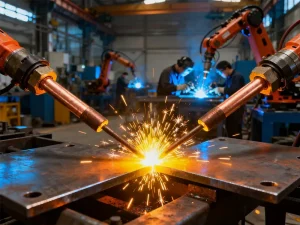
As I said above, spot welding has become the most popular welding method nowadays, but for a reason! It provides several unique advantages that make it fast, reliable, and cost-effective. But that’s not it! Let’s discuss what actually makes the spot welding stand out in this section.
1- Fast and Efficient
One of the most significant advantages of spot welding is its high speed. As you know, the spot welding process uses electricity to make a weld. This electricity takes only a few seconds to heat and melt the metal surface. As a result, you get welds faster. Moreover, in spot welding, you can also make more than one weld at a time. This further reduces your time and efforts.
2- No Need for Filler Material
In spot welding, you don’t need to use any filler to join the metals. As I said above, this process uses only electricity and electrode pressure to join the metal surfaces. It means you don’t have to arrange extra materials like rods or glue. As a result, you get a clean and smooth weld. This not only saves your time but also reduces the material waste.
3- Strong Joints
The welds made by spot-welding are robust. The heat generated by the current melts the metal, creating a strong joint between the two metals. These welds are strong enough to withstand heavy loads and stress without breaking. Moreover, there is no use of extra filler that can cause porosity in welding. That’s why spot welding is commonly used in the manufacture of metal furniture.
4- Low Production Cost
Another top-notch benefit of spot welding is its lower cost. HOW? Actually, this process is swift because it uses electricity. It means it creates more welds in less time. This reduces the cost per weld, making it highly beneficial for mass production. Moreover, spot welding machines are usually automated, which reduces labor costs. Overall, spot welding is cost-effective for large factories and industries.
5- Simple and Safe Process
Spot welding is a safe, simple process. Why? Because it does not require any complex tools or special skills. The welding machines apply pressure and current to create a strong weld. There is no need for the operator to do any task. You just have to place the metal pieces correctly. This reduced human involvement makes the process safer. Moreover, unlike other types of welding, spot welding does not produce fumes or open flames. So you can easily handle it.
Disadvantages of Spot Welding
Like any metalworking technique, spot welding is not always perfect. Before you start this process, there are some drawbacks you should consider. Which one? Here is the short list!
1- Limited to Thin Sheets
First of all, spot welding only works best for thin metal sheets. The reason is that an electric current can heat only a small area of the metal, melting it. If the metal is thick, the current cannot heat in depth. As a result, the weld will be weak or incomplete. It means the spot welding cannot join heavy metals.
2- Not Suitable for All Metals
Spot welding is not suitable for every type of metal. WHY? Because some metals, like brass and zinc, cannot conduct electricity. As a result, when the current passes through such metals, it cannot produce heat. So, the weld is not made. In simple words, spot welding works best for metals that conduct electricity. Those metals include steel, stainless steel, nickel alloys, Inconel, and titanium.
3- Weak Aesthetic Appearance
As I said above, spot welding creates a weld at a small surface area. At this surface, it leaves minor, round marks, known as weld nuggets. These marks on the final shape can affect the aesthetics of metal, making it uneven and rough. Therefore, I don’t recommend spot welding for applications where appearance is critical.
4- Requires Proper Alignment
Another drawback of spot welding is that it requires proper alignment of metal sheets. During metal sheet welding, you must properly position the sheets between the electrodes. Also, the metals themselves should be correctly placed on top of each other. Even a slight gap or misalignment between metals can lead to weak or uneven welds. In simple terms, you have to be more careful when placing metals, which takes time.
5- Limited Joint Types
As you can see, in spot-welding, metal sheets are placed on top of each other. So we can say that spot welding works only for two overlapping metal sheets. The reason is that the welding electrode must make contact with both sides of the metal to pass current. Because of this, you cannot weld metals of different shapes, like T shapes or around corners. Spot welding works best only for flat metal sheets.
Conclusion
Spot welding is one of the most widely used welding techniques in metalworking. What makes it a top-notch choice across several industries is its simplicity and efficiency. Spot welding uses the current and pressure of electrodes to create a joint between two metals. However, the weld is made at a tiny spot. That’s why it is called spot welding.
Moreover, spot welding produces robust, fast, and clean welds. You don’t have to use extra fillers, which saves cost and time. However, like any method, spot welding has some drawbacks. For example, it works for flat metal surfaces. Also, spot welding is limited to thin sheets and does not offer aesthetics. Before starting spot welding, I recommend considering the pros and cons to avoid unwanted results.